
Most content libraries are not short on articles. They are short on a defensible way to decide which articles deserve a second life, and a production system that can deliver that second life at pace.
That was the starting point for a global endurance sports brand with roughly 750 legacy articles written across a decade.
- Training guides
- Nutrition explainers
- Gear selection pieces
- Race-day checklists
When the first batch was pulled into analytics, 19 of the first 21 pages reviewed had recorded zero organic traffic for more than 18 months. Not low traffic. Zero.
The instinct, when leadership asks for more organic traffic, is to commission new content. A new article feels cleaner than repairing the old estate.
But a brand-new page starts with no authority, no backlinks, no history in the index, and no proof that anyone wants it. A decayed page often has some of those assets already. It simply stopped deserving the ranking it once held.
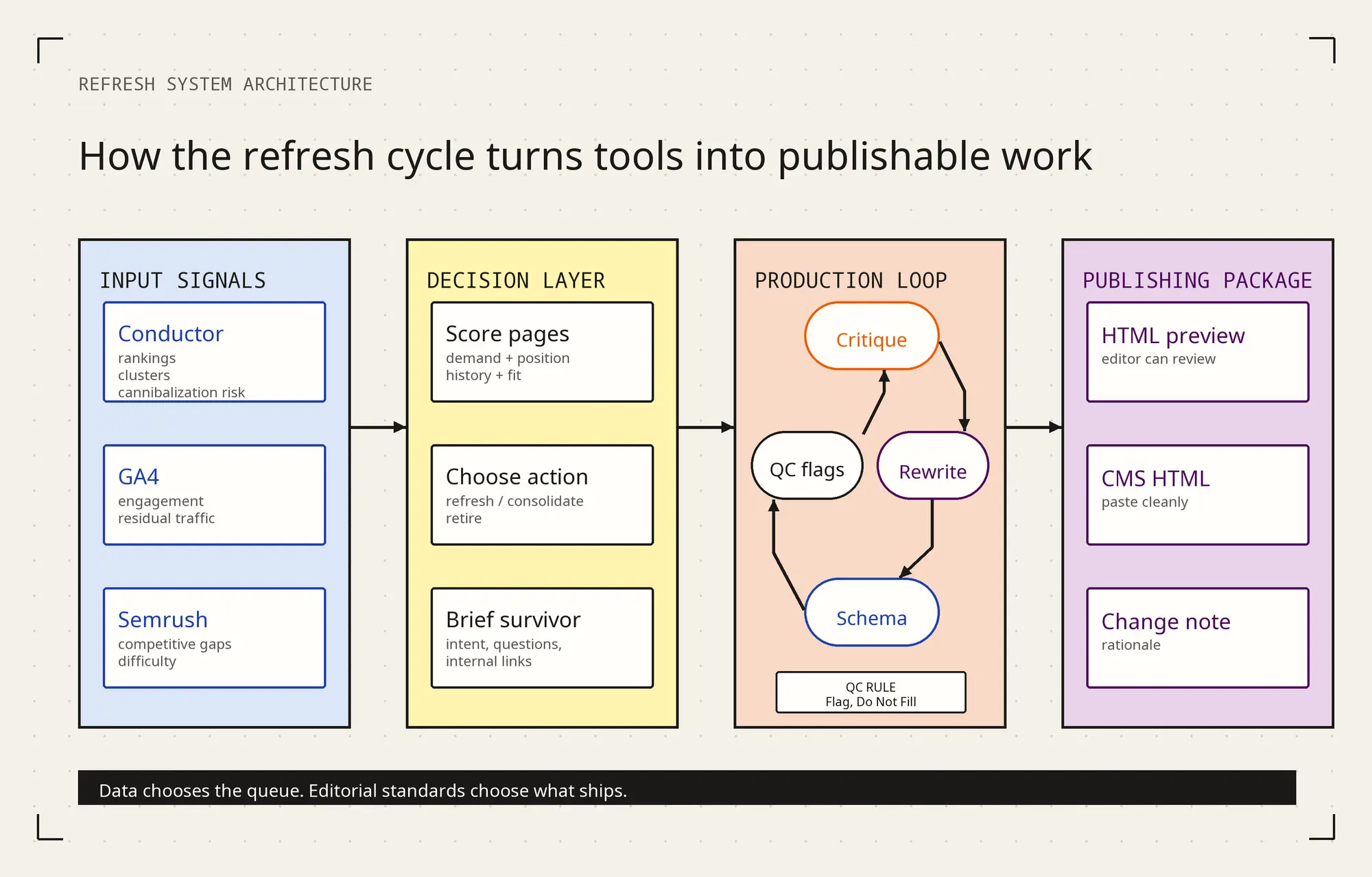
The operational question was not, “can we write more?” It was, “which existing pages deserve a second life, and how do we refresh them without creating a new review burden?” That is where Conductor, GA4 and Semrush became the decision layer, and an in-house agentic refresh cycle became the production layer.
The Problem Nobody Wanted To Own
Every organization that has published consistently for ten years is sitting on a library where most of the value has quietly decayed.
- The pages still exist.
- The CMS still serves them.
- The sitemap still exposes them.
But search demand has moved, competing pages have improved, snippets have changed, and old advice has become incomplete or risky.
This project had one additional constraint: trust.
A contractor had already been asked to refresh a large chunk of the archive. When those drafts were reviewed before publishing, the team found:
- Misclaims carried over from the originals.
- Factually wrong statements introduced during the rewrite.
- A review burden that made scale risky.
The library was too big to review by hand, too valuable to ignore, and too risky to publish without a check.
Client review time was the scarcest resource. The content lead could approve decisions, but she could not rewrite dozens of pages herself. The digital platforms lead was moving into a mobile app launch. The system had to make the review smaller, not just the writing faster.
The useful output was not a batch of drafts. It was a ranked queue, a refresh system, and a short list of editorial decisions the client could trust.
Step One: Let The Data Pick The Pages
We did not start with the content. We started with a three-way triangulation across Conductor, GA4 and Semrush to decide which pages were worth the effort.
- Conductor gave us the page-level picture: which URLs still ranked, which keyword clusters had demand the site was not capturing, and which existing pages were cannibalizing each other.
- GA4 showed where residual engagement still lived.
- Semrush added competitive gap and keyword difficulty, so the team could avoid spending a refresh on topics stronger publishers had already locked up.
The output was a ranked list, not a content calendar. Each page was scored on:
- Search demand
- Current ranking position
- Historical traffic
- Residual impressions
- Click-through rate
- Strategic fit with the brand’s audience personas
A page with residual impressions but a collapsed click-through rate scored high because the intent was clearly still alive. A page on a topic where the brand had no credible angle scored low, even when volume looked attractive.
That human judgment matters. A refresh program is not a content farm. It needs to ask whether the brand is entitled to rank for the topic, whether the advice can be made accurate, and whether the page supports the audience the brand wants to serve. Tools can surface the opportunity. They cannot decide whether the brand has a defensible point of view.
Conductor’s cannibalization check mattered more than expected. Several topics had three or four legacy articles competing for the same query. Refreshing all of them would have made the problem worse. The right move was to consolidate, pick one canonical page, redirect the rest, and refresh only the survivor. That same principle shows up in our multi-location SEO work: reduce confusion before adding more pages.
Step Two: Rebuild Around Real Intent, Not The Old Outline
This is where the agentic content system plugged into Conductor.
Conductor produced the brief: target keyword clusters, questions people ask, competing page structure and a content score showing how far the current page sat from what ranks.
On its own, that brief was a strong starting point and a poor finished article. It was keyword-led by design. The brand’s content strategy was persona-led and deliberately not keyword-heavy, so a draft that chased the brief too literally read like every other page on the results page.
The refresh cycle treated Conductor’s brief as one input among several. First came a critique pass against a scoring rubric:
- Does it answer the question in the first hundred words?
- Are claims sourced?
- Is the structure aligned with how people actually ask?
- Does the article contradict itself?
- Is the advice safe?
Every issue received a severity and a verdict. The piece either moved to rewrite or was flagged for human decision.
The rewrite pass rebuilt the article around intent while preserving the author’s expertise and the brand’s voice. Headings became the questions people ask. Answers moved to the top of each section. Lists that promised ten items and delivered thirteen were fixed. Terminology was checked against a house-style dictionary so race names, distances and brand terms stayed consistent.
A scaffolding pass added what search and AI engines need to parse the page:
- Title tag
- Meta description
- Short answer capsule
- FAQ block built from real questions
- Article and FAQ structured data, generated and validated automatically
The same pass proposed internal links so refreshed articles reinforced each other as a cluster.
Finally, a quality-control pass ran the mandatory pre-delivery checklist: house style, US spelling, nomenclature, health-disclaimer rules for training load or nutrition content, and a hard rule we call flag, do not fill.
If the system could not verify a claim, it did not invent a replacement. It flagged the claim for the editor.
That one rule let the client’s content lead trust the output. She was not reviewing prose from scratch. She was reviewing a short list of decisions.
Step Three: Hand Back Something Publishable
Each article came out of the cycle as a publishable package:
- A rewritten draft
- A self-contained HTML preview the client could open in a browser
- The schema block
- A change note listing what changed and why
Editors pasted the HTML into the CMS. No developer tickets. No formatting cleanup. No hidden dependency on a specialized publishing sprint.
The team considered two alternatives and rejected both:
- Relying on Conductor’s native AI writing assistant alone created drafts that needed heavy editorial rework before approval, and the workflow could stall on niche or branded topics that lacked enough competitor URLs.
- Running the refresh fully by hand produced stronger editorial control but took roughly four hours per article, which did not scale to a 750-page archive.
The hybrid was less autonomous than the client originally hoped. It was also the only version that produced pages she was willing to put her name on. AI-native delivery does not mean removing the human standard. It means compressing the path to a trustworthy decision.
It also exposed a familiar last-mile problem. Research and writing can move quickly, but the work only lands when the CMS, design system and editorial workflow accept it cleanly. That is why this project connects directly to our work on the last mile between AI content platforms and Drupal, and to the broader question of content operations in composable DXP programs.
What Changed
Forty-five refreshed pages went live between late June and late August. Over those nine weeks, they produced:
- Roughly 15,900 organic sessions
- 1.03 million search impressions
- About 10,600 clicks
- Just over 10,000 sessions in the most recent week
That final week was a 107 percent increase in weekly organic sessions against the previous reporting period. Average search position across the refreshed set settled between six and seven.
The technical footprint moved with it. Before the refresh, 7 of the 45 pages carried structured data. Afterward, all 45 did, and all 45 were confirmed indexable. That is not a vanity metric. It is the difference between a page that search and AI systems can parse as an answer and a page they treat as prose.
Individual pages told the sharper story:
- A 16-week training plan article that had been effectively dead drew 1,855 sessions at an 8.7 percent click-through rate.
- A gear-selection explainer pulled 1,007 sessions.
- A readiness self-assessment piece pulled 1,005 sessions.
All three had been in the zero-traffic pile a quarter earlier. Read time on the training plan piece averaged more than four and a half minutes, which for a mobile-heavy audience suggested the restructuring worked, not just the ranking.
There was still an honest edge. Click-through rate across the set was volatile: 1.4 percent, then 2.0, then 0.6 for two weeks, then back to 1.3. Rankings recovered faster than clicks did.
One nutrition article made the issue impossible to ignore: 193,745 impressions in the period at a 0.2 percent click-through rate. It became the single largest opportunity on the site, and it remained unsolved.
The refresh cycle fixed the page. It had not yet fixed the snippet.
What You Can Take From This
If your content library is older than three years, assume a large share of its value has decayed. The fastest traffic you can earn this quarter may already be sitting in the archive.
Before briefing a new article, score what you already have. At minimum, the score should include:
- Search demand
- Current position
- Historical engagement
- Whether your brand has a credible claim to the topic
Conductor, or any platform that joins keyword data to page data, gets you the first three. The fourth is a human judgment.
Then separate the platform’s job from the editorial job.
- Let the platform decide what to refresh and what the page needs to compete.
- Let a system with your house rules decide how the page reads, whether the claims hold and what should be flagged rather than fixed.
When one tool tried to do both jobs, quality dropped and client review time went up. When the jobs were split, review became a list of decisions rather than a rewrite.
Budget for the second problem as well. Rankings often return before clicks do. Plan a title and snippet optimization pass as a separate workstream that starts the week refreshed pages begin earning impressions, because that is when you finally have data on what people are choosing instead of you.
This is the output we can own: the ranked refresh queue, the production system, the technical markup, the editorial safeguards and the next optimization loop. The client owns the business hypothesis those outputs support. That separation keeps the work useful, honest and repeatable.
If Your Archive Is The Untapped Channel
If you are staring at a large archive and cannot tell which pages deserve a second life, we can run the prioritization with you and show what a refresh cycle looks like on your own content.
Send us a domain, and we will come back with the pages we would refresh first, the reason they scored highly and the editorial risks we would want to check before publishing.
- Explore RevOps & Growth if the problem is pipeline, campaign velocity or organic demand.
- See our Acquia work if your content estate sits on Drupal or Acquia.
- Start a conversation if you want a practical read on the first 25 pages to refresh.
Bring this dispatch into a working session - one page in, scoping memo out.
Brief Foyer