
Here's a pattern we keep seeing. A team adopts Copilot, Cursor, or some other AI coding assistant. Individual developer output goes up. Pull requests arrive faster. Code generation accelerates.
And six months later, delivery timelines haven't meaningfully changed.
The sprint velocity charts look better. The throughput numbers are up. But the actual outcomes - features shipped to production, client satisfaction, defect rates, time-to-value on complex integrations - sit roughly where they were before. Sometimes worse, because the faster individual outputs created more integration work downstream.
This isn't a tooling failure. The tools work. The models are genuinely capable. The problem is structural, and it sits in a layer that most teams haven't built yet.
The context gap
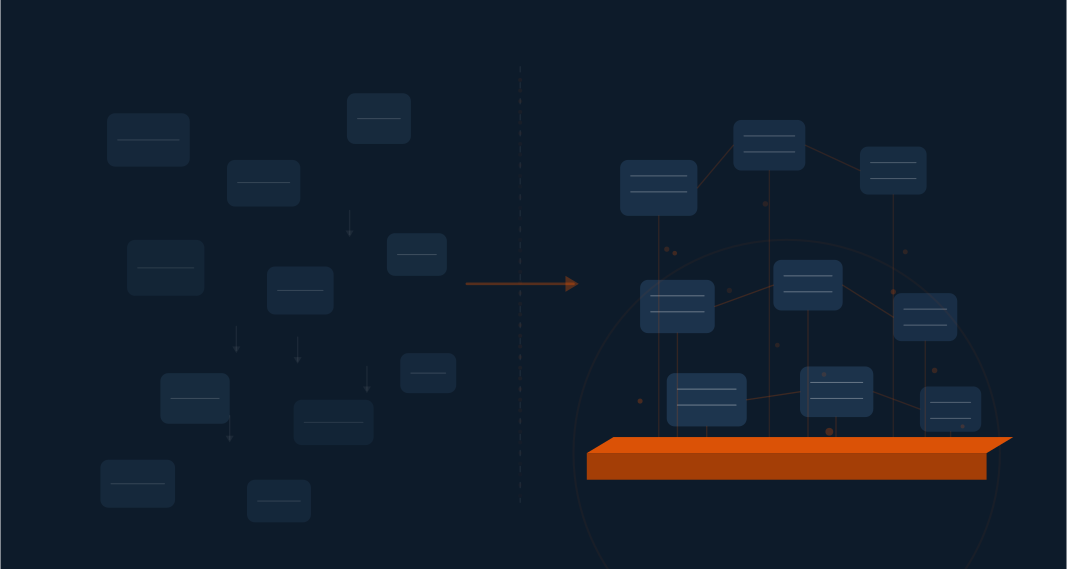
Every AI tool in a typical delivery workflow operates in isolation. The coding assistant knows the current file and maybe the surrounding codebase. It doesn't know that three months ago, the architect made a deliberate decision to avoid that pattern because of a production incident. It doesn't know that the field it's mapping to in Salesforce was deprecated last sprint. It doesn't know that the client's compliance team requires specific logging on any API that touches PII.
That knowledge lives in Slack threads, Jira ticket histories, Confluence pages, meeting recordings, and - most often - in someone's head. The AI tools can't access it. So they produce outputs that are fast, syntactically correct, and contextually wrong.
The human engineers catch the contextual errors. They review, correct, and adjust. This is the hidden cost of context-free AI: the review burden shifts from "is this code correct?" to "is this code correct *for our specific situation?*" That second question takes longer to answer. It requires more senior attention. And it scales with the number of AI-generated outputs, which means the faster the tools produce, the more review work they create.
We've measured this across engagements. On complex multi-platform work, teams using AI coding assistants without a shared context layer spend 30-40% of senior engineer time on contextual review that wouldn't have been needed if the AI had access to institutional knowledge in the first place.
Three gaps, not one
The intelligence gap isn't just about context. It's three compounding problems.
Context gap: AI doesn't know your institutional history, conventions, constraints, or prior decisions. Every engagement starts from zero. Every agent operates with amnesia.
Trust gap: There's no governance model for how AI outputs move from draft to production. Either humans review everything (which negates the speed advantage) or nothing (which creates quality risk). Most teams oscillate between both extremes depending on deadline pressure.
Transparency gap: When AI is involved in delivery, nobody can see how. Clients don't know which outputs had AI involvement. Team leads can't tell which agent actions were approved versus autonomous. When something goes wrong, the audit trail doesn't exist.
These three gaps are why faster tools don't produce better outcomes. Speed without context creates more defects. Speed without trust governance creates quality incidents. Speed without transparency erodes the client relationship that the entire engagement depends on.
The equation that's actually broken
The traditional delivery model calculates output as a function of team size, hours, and skill level. AI tools accelerate the "hours" variable - they make each hour more productive. But the binding constraint on complex delivery was never hours. It was the quality of decisions made during those hours.
A better model: Output = Operators × Agent Leverage × Context Depth.
Operators are experienced professionals who know when to trust the agent output and when to override it - AI handles volume, humans handle judgment. Agent leverage is the actual capability of the AI systems. Context depth is the institutional knowledge available to both the human and the AI at the point of decision. Agent leverage scales with the system, not with team size. Context depth compounds over time. The result: the same engagement delivers 3-5x more value as the intelligence matures - because the system gets smarter, not just busier.
Most teams have invested in agent leverage - better tools, more capable models. Almost nobody has invested in context depth. That's the gap.
What you can take from this
If you're evaluating AI-augmented delivery - whether from a vendor, a partner, or your internal team - ask one question: "Where does the context come from?"
If the answer is "the AI has access to the codebase," that's table stakes. If the answer is "the AI has access to the codebase, the ticket history, the Slack threads, the architectural decisions, the client's compliance constraints, and the production incident log - and all of that compounds over time," that's a different category of delivery entirely.
The tools are fast enough. The models are capable enough. The gap is context. Close that, and the rest follows.
Bring this dispatch into a working session - one page in, scoping memo out.
Brief Foyer