Most AI deployments start with a lie.
The lie goes like this: "We'll add AI to our delivery workflow, and it'll just work." The coding assistant will know your conventions. The QA agent will understand your failure patterns. The automation will slot into your team's rhythm without friction.
It doesn't happen that way. What actually happens is one of two failure modes - and we've watched both play out across enough engagements to be confident about this.
Failure mode one: full stealth. AI tools run behind the scenes, nobody talks about them, nobody governs them. When something breaks - and it always breaks eventually - nobody knows which output was human and which was machine. Accountability disappears. The client loses trust not in the AI, but in the team.
Failure mode two: full autonomy from day one. The agents ship code, respond to tickets, push content - all under their own identity, immediately. The team hasn't calibrated. The client hasn't built confidence. One bad output in week two, and the entire AI integration gets pulled. We've seen this happen on a live engagement. The rollback cost more than the original setup.
Both modes share the same root problem: they treat trust as a binary. AI is either hidden or unleashed. There's no middle ground, no progression, no governance.
We needed a middle ground. So we built one.
Three stages, not a switch
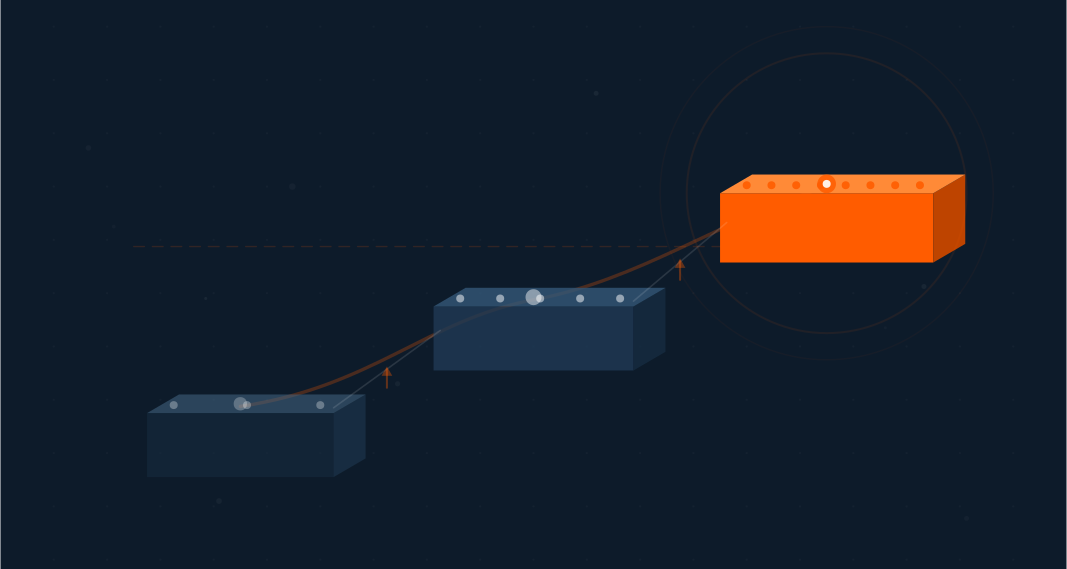
The trust model we operate has three stages: Invisible, Visible, and Autonomous. Every AI agent in our delivery system starts at Invisible - no exceptions.
Invisible means the agent does real work, but a human operator publishes it. The agent drafts the pull request; the operator reviews, adjusts, and submits it. The agent writes the QA report; the operator signs off. The client sees high-quality output. They don't yet see who - or what - produced the first draft. This isn't deception. It's calibration. The operator is learning the agent's strengths and failure patterns in production conditions, not in a sandbox.
Visible means the agent gets a named identity. The client knows "this pull request was drafted by the Code Agent and reviewed by your operator." The agent's work is attributed. Its approval rate is tracked. The client starts seeing the human-machine collaboration directly - and they start trusting it, because the quality has already been proven during the invisible phase.
Autonomous means the agent operates with graduated independence. Not unsupervised - graduated. Certain action types that have hit a consistent approval threshold (we use 90%) can proceed without human review. Others still require operator sign-off. Every autonomous action is logged, auditable, and reversible.
The key insight: each stage transition is driven by data, not by schedule. An agent doesn't become Visible because six weeks passed. It becomes Visible because its approval rate crossed the threshold and the operator confirmed readiness. An agent doesn't become Autonomous because someone decided it was time. It becomes Autonomous because the evidence justified it.
Why this matters beyond methodology
On one engagement - a media technology company with a complex integration stack - we moved from Invisible to Visible in six weeks, on the back of 100% accuracy during the invisible phase. Autonomous came at week eight, with zero regressions. The trust model didn't just govern the AI; it became the mechanism through which the client expanded the engagement. They could see exactly what each agent was doing, how accurate it was, and how much the human operators were adding on top. That transparency drove a 6.4x expansion in scope over 18 months - across HubSpot, middleware, and marketing systems.
The expansion didn't come from a pitch deck. It came from a dashboard.
This is the part most AI-augmented delivery approaches miss entirely. Trust isn't a prerequisite you establish once at kickoff. It's a system you build, measure, and compound over time. When you have real data showing agent approval rates climbing from 60% to 97%, you're not asking the client to believe you. You're showing them.
What you can take from this
If you're integrating AI agents into delivery - whether that's code generation, QA automation, content ops, or anything else - the question isn't "how capable is the AI?" The question is "how will trust be governed?"
Start invisible. Let the humans calibrate. Make the transition to visibility data-driven, not calendar-driven. And never, ever deploy with full autonomy on day one.
The capability is table stakes now. The governance is the differentiator.
Bring this dispatch into a working session - one page in, scoping memo out.
Brief Foyer