
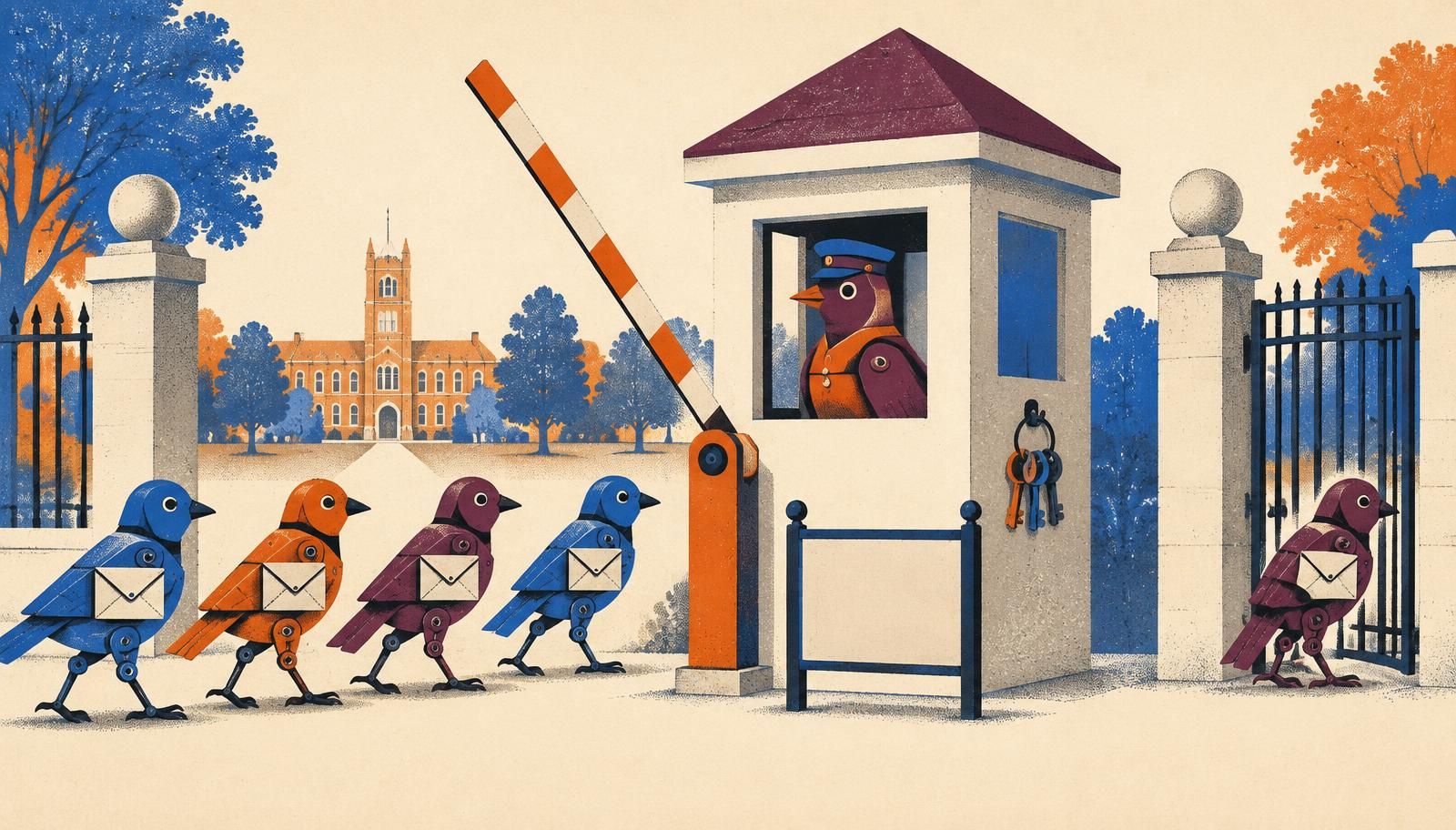
Forty eight of the fifty two UK universities whose robots.txt we could read name no AI crawler at all. Not one asked an answer engine to stay out. Six of them block answer engines anyway, at the network edge, while their robots.txt says nothing about it. That combination is the single most expensive pattern in the audit, because it removes an institution from AI answers without anyone deciding to.
An AI crawler policy is not a robots.txt file. It is a decision about three different jobs that AI agents do, written down once, then expressed consistently at every layer that can refuse a request. Most estates have never taken the decision, and the layers contradict each other by default.
The figures here come from our audit of 64 UK higher education websites, run in August 2026.
What the audit found
Read the last two bars together. Zero institutions asked answer engines to stay away in the file that states intent, and eleven percent turned them away in the layer that enforces it. The block is almost never a policy. It is a managed bot rule switched on during an incident, a rate limit tuned for a clearing day, or a challenge page applied to everything without a browser.
Four institutions had taken a deliberate position and written it down. That is the group worth copying, whichever way they decided, because their file and their edge agreed with each other.
Three jobs, three decisions
The reason blanket rules go wrong is that AI agents fetch pages for reasons that carry completely different consequences for an institution.
Training crawlers collect pages to train future models. Nothing comes back in the same cycle, and whether you allow them is a genuine institutional choice involving research output, licensed material, and student contributions. Reasonable universities land on both sides of it.
Search index crawlers are the ones that build the index an answer engine cites when a prospective student asks about your courses. Blocking those does not protect anything. It removes the institution from the answer and leaves the field to league tables, forums, and competitors who stayed readable.
User requested fetches happen because a person asked an assistant about a specific page. Treat that agent as a visitor with a tool, not as a scraper. Blocking it means an applicant looking at your course page gets told the page cannot be read.
One consequence worth stating plainly: a policy of allow search, decide separately on training is coherent, defensible, and expressible in a dozen lines. A single Disallow all applied to every AI agent is none of those things.
Where a crawler is actually refused
robots.txt is a declaration. It is honored by the major vendors and it is the right place to state intent. It is also the last of four layers that can refuse the request, and the only one the web team usually owns.
This is why the audit checked edge behavior separately from robots.txt. A managed AI bot category at the CDN, a JavaScript challenge in the WAF, or a rate ceiling set per user agent all produce the same outcome as a disallow, with none of the visibility. The web team sees a correct robots.txt and a well marked up page. The answer engine sees a challenge page it cannot solve.
Audit top down. If layer one refuses the fetch, nothing you do in layers three and four is ever read.
Writing the policy: a shape that holds
A workable higher education AI crawler policy is short. It names the agents, states the decision per job, and records who owns the review.
- Allow answer engine crawlers explicitly, by name, rather than relying on a default allow that a future edge rule can silently reverse.
- Allow user requested fetch agents explicitly, for the same reason.
- Take a stated position on training crawlers, allow or disallow, and record the reasoning and the approving body. An unstated position is not neutrality, it is drift.
- Disallow the paths that should never be quoted: staff only areas, search result URLs, session and basket paths, application portals, anything behind a login.
- Keep the sitemap lines in the same file, and point at the canonical fee, entry requirement, and accommodation pages.
- Name an owner and a review cadence. Agent names change several times a year, so a file written once and forgotten is a file that will be wrong by the next cycle.
Then make the edge match. That means an inventory of bot rules, managed categories, and rate limits, agreed with whoever owns the CDN, and a check that the agents you allowed in robots.txt actually receive a two hundred response.
What a policy does not do
Two limits are worth being honest about, because overstating either wastes a program's credibility.
- robots.txt is voluntary. It governs the vendors who publish and honor agent names. It is not a security control, and it will not stop an agent that ignores it. If content must not leave, it needs authentication, not a directive.
- Disallowing a training crawler does not remove material already used. It applies going forward. Treat it as a forward looking statement of position, not a retraction.
Both points argue for the same thing: state the position clearly, enforce it where enforcement actually lives, and put the effort you save into making the pages you do want quoted readable.
The order that works
- Reconcile the layers first. Confirm what your CDN, WAF, and rate limits do to each named agent today, before touching a text file.
- Take the training decision at the right level, with research, legal, and marketing in the room, and write it down.
- Publish robots.txt with named allows, named disallows, and sitemap lines.
- Make the allowed pages worth quoting: server rendered facts and course markup, as covered in structured data for university course pages and publishing fees, entry requirements and accommodation costs.
- Add llms.txt last, as curation on top of a readable estate, not as a substitute for one.
Steps one and two are the ones that stall, because they cross team boundaries rather than technical ones. That pattern is the same one we described in composable DXP programs: the architecture is rarely the blocker, the operating model is. Clearing the edge is platform engineering work, and the readability layer sits with discoverability.
How to check your own estate this week
- Fetch your robots.txt and list every user agent named. If no AI agent appears, you have no stated position.
- Request a course page with each answer engine user agent string and record the status code. Anything other than two hundred is a block you did not know about.
- Ask the CDN owner for the active bot management rules and managed categories, in writing.
- Ask ChatGPT, Gemini, and Perplexity a course question for a named program and see who gets cited. If it is a league table, start at layer one.
Our AI visibility audit runs the edge, render, and citation checks against a domain together, which is what separates a policy problem from a content problem.
Policy is easier when the estate is one platform
Crawler policy is hard to enforce across an estate that grew as separate systems, because every subdomain carries its own robots file, its own headers and its own owner. The University of East London consolidated a fragmented estate onto a single platform with a unified data and integration layer, which is what makes a single policy decision actually apply everywhere it is supposed to.
The practical lesson is that allow and block rules are a consequence of estate structure, not a substitute for it. One platform, one canonical page per course, one place to state the rule. The consolidation is described in the University of East London case study.
Frequently asked questions
Should a university block AI crawlers?
Split the question. Blocking answer engine search crawlers removes the institution from AI answers about its own courses, which almost no university wants. Blocking training crawlers is a legitimate institutional decision with arguments on both sides. Treat them as two separate directives, taken by different people.
Does blocking GPTBot stop ChatGPT citing our pages?
No. GPTBot collects training data. The agents that support citation in ChatGPT search and on demand fetches are named separately, so a GPTBot disallow leaves search visibility intact. That distinction is exactly why blanket rules cause unintended damage.
Is robots.txt enough?
It is necessary and not sufficient. It states intent, and the major vendors honor it, but any refusal at the CDN or WAF overrides it in practice. Eleven percent of the institutions we audited were blocking at those layers with a robots.txt that said nothing.
How often should the policy be reviewed?
Once a term is a reasonable cadence, plus a check whenever a vendor announces a new agent. Names and behaviors change often enough that annual review leaves a file wrong for most of the year.
Who should own this at an institution?
The decision belongs with the group that can speak for research, legal, and recruitment together. The implementation belongs with whoever owns the CDN and the origin, jointly. The failure mode we see is a policy owned by nobody and enforced by an incident response rule.
Where to start
Read your own robots.txt, then ask your CDN owner what the edge does. If the two disagree, that is the finding, and it outranks everything else on the list. The full 64 institution report has the comparative picture, and the markup, course facts, and llms.txt guides cover the readability layer once the fetch is clear. We work with higher education institutions across that chain, and you can talk to us about your own estate.
Read next
Once the fetch is clear, the question is whether the page is readable at all. WCAG 2.2 for university websites covers the accessibility work that puts course facts into semantic HTML, which is the same substrate an answer engine reads.
The same governance gap shows up in a document rather than a file: accessibility statements in higher education, where a claim published in 2020 still describes an estate that has since been rebuilt.
Crawl policy only pays off if the page is worth fetching. SEO for universities sets out the estate level work that decides that, including the four or five URLs competing for one course query.
Crawl policy needs a named owner, which is a planning question: higher education digital strategy sets out where that ownership sits.
Working on a university estate rather than a single page? Our higher education practice page sets out how the strategy, design, engineering and marketing work runs as one team, and the UK higher education AI discoverability report holds the audit data behind this series. Also worth reading: Student recruitment marketing, Choosing a CMS for a university estate.
For the same audit read as a marketing diagnosis, see higher education marketing: what an audit of 64 UK university websites reveals.
A crawl policy only helps if the pages behind it are built to be read, which is a design question: university website design.
Bring this dispatch into a working session - one page in, scoping memo out.
Brief Foyer