
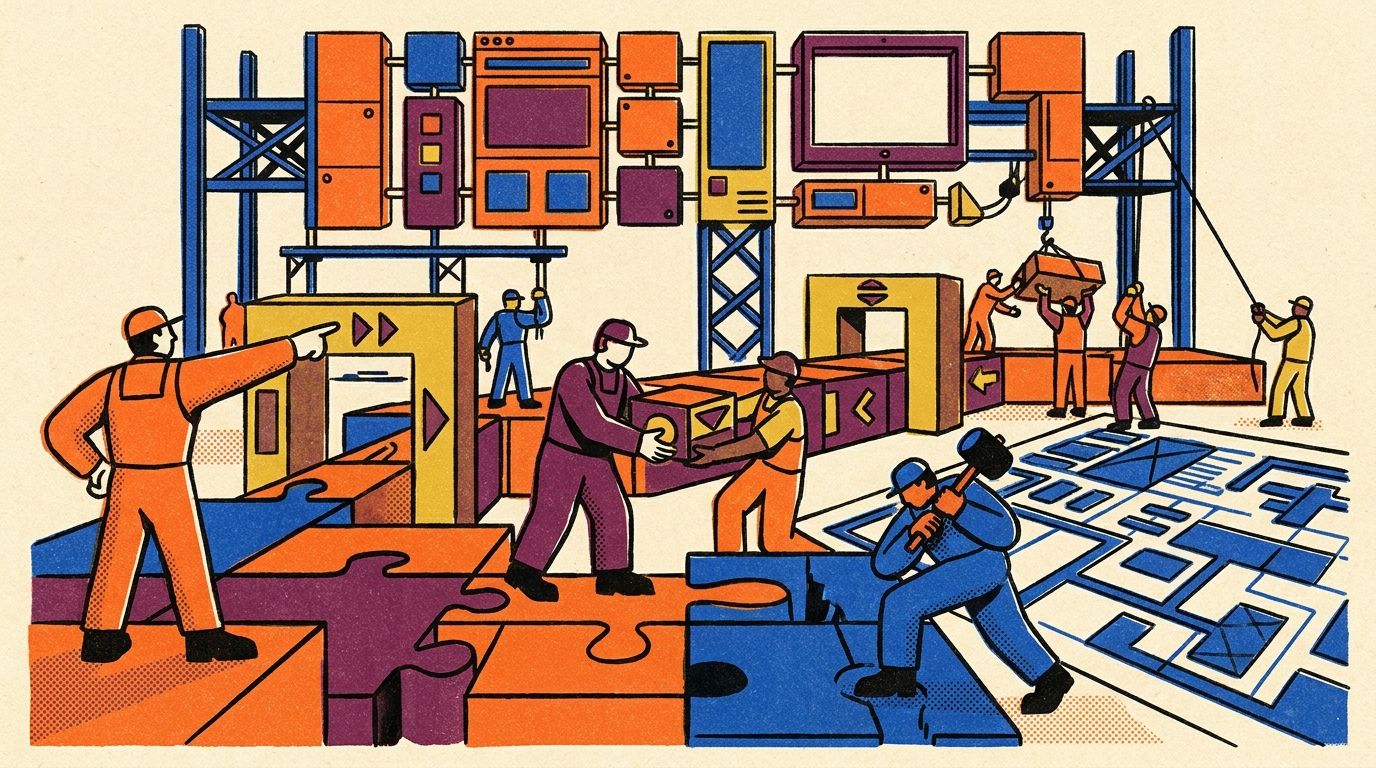
Digital delivery failure is overwhelmingly a governance, readiness, and sequencing problem. The industry just refuses to talk about it that way.
The digital industry has a comfortable explanation for why platform migrations stall, content operations miss their deadlines, and composable architecture bets underdeliver. The explanation goes like this: the technology was more complex than expected. The team underestimated the integration challenge. The platform had limitations nobody surfaced during evaluation.
It is a comforting story because it keeps the failure inside a domain we already know how to resource: engineering. Hire more engineers. Evaluate platforms more carefully. Run a longer proof of concept.
The pattern we keep seeing across engagements tells a different story. The technology was fine. The governance was missing.
Why the conventional sequence fails
The standard delivery sequence for a digital platform migration or content operations transformation runs roughly like this: select the platform, design the front end, build the integrations, migrate the content, figure out who owns what. Governance is the last conversation, if it happens at all.
This sequence feels logical. You cannot govern something that does not exist yet, so you build first and govern later.
The problem is that every decision in the build encodes governance assumptions. A content model assumes someone will maintain its taxonomy. A composable architecture assumes someone will decide which components are canonical. A migration assumes someone has authority to retire, merge, or restructure the content being moved. When no one holds that authority, the build does not fail dramatically. It stalls quietly. Decisions queue up waiting for an owner who was never named.
The dependency chain runs in the opposite direction from how most teams sequence it:
- You cannot migrate content without a content model that defines what moves, what merges, and what dies.
- You cannot finalize a content model without a governance owner who has authority over taxonomy, structure, and lifecycle decisions.
- You cannot evaluate architecture honestly without understanding whether the organization can operate what it is buying.
- You cannot build a front end against a content model that is still being negotiated.
The assessment determines the architecture. The architecture determines the platform, not the other way around. When teams start with platform selection, they are locking in technical decisions before they understand the organizational shape of the problem.
The loop as the alternative
Axelerant's Experience-Data-Activation-Optimization loop is not a project management methodology. It is a diagnostic lens for understanding where a delivery engagement actually sits and what it depends on.
The loop's core logic is sequential dependency. Each experience generates data. Data informs activation. Optimization closes the loop and feeds back. You cannot activate revenue without a data layer. You cannot optimize what you cannot measure. And you cannot build a data layer on an experience architecture that does not generate clean data.
Applied to digital delivery, this means the first question is never "which platform?" It is "what does the experience need to produce, and who governs the decisions that shape it?"
What it looks like in practice
Across recent engagements, this thesis has surfaced repeatedly in different forms, each reinforcing the same structural point.
The editorial governance gap
During a content operations migration, the delivery team discovered mid-migration that no one at the client organization had defined ownership for content model decisions. Not the CMS administrator. Not the editorial team. Not the product owner. The content model was being designed by engineers making reasonable assumptions in the absence of editorial authority. Delivery stalled, not because the migration tooling failed, but because every structural content decision required a sign-off chain that did not exist. The governance vacuum was invisible during platform selection. It became the primary delivery risk once real content needed real decisions.
The composable architecture readiness mismatch
On the same engagement, the team evaluated composable architecture options and found that technical merit alone was an insufficient selection criterion. The organization's readiness to operate a composable stack, to maintain independent services, to coordinate releases across decoupled front ends, and to staff the ongoing architectural decisions a headless approach demands was not commensurate with the ambition of what was being evaluated. A technically superior architecture becomes a delivery liability when the organization cannot operate it. Weighting delivery risk, team capability, and organizational readiness equally with technical merit changed the evaluation entirely.
The content modeling inversion
The team observed a structural pattern in how delivery capacity was being allocated: front-end build was consuming the majority of team time and budget, while content modeling was treated as a downstream task. The result was predictable. Late-stage rework. Front-end components built against placeholder content structures that did not survive contact with real editorial workflows. The fix was not more front-end engineers. It was inverting the sequence: content model first, validated against real content and real editorial governance, then front-end build against a stable structure.
The AI judgment redistribution
When the team experimented with AI-assisted delivery patterns, the expectation from the outside was straightforward: AI compresses team size. What actually happened was different. Senior judgment did not disappear. It redistributed. It moved earlier in the process, into scoping and prompt design, and later, into QA and validation. The middle, the organizing and drafting load, got lighter. But the ends got heavier. Human-led, AI-shouldered delivery is not a headcount story. It is a judgment-allocation story.
What this thesis does not solve
Two honest boundaries matter here.
First, the strategy stance. This framework diagnoses where delivery is stuck and what depends on what. It sequences the work. It does not author the client's strategy. Whether an organization should pursue composable architecture, whether it should invest in answer-engine optimization, and whether it should restructure its content operations are strategic decisions that belong to the client. The loop tells you that making those decisions after the build has started is expensive. It does not tell you what to decide.
Second, humility about our own practice. We apply this lens engagement by engagement, and parts of our own practice are still maturing. Most engagements do not begin at the beginning. They begin mid-sequence, with platform decisions already made, governance partially defined, and content models partially built. Entering mid-sequence is normal. The value of the lens is not that it prevents imperfect starting points. It is that it names the dependencies honestly so teams can address the gaps that will stall them rather than discovering those gaps at the worst possible moment.
The governance-first thesis does not make delivery easy. It makes the hard parts visible earlier, when they are cheaper to address and before they have calcified into architecture.
One thing to do next
If your digital delivery feels stuck in a way that more engineering cannot fix, explore how the Experience-Data-Activation-Optimization loop sequences the work.
Bring this dispatch into a working session - one page in, scoping memo out.
Brief Foyer