
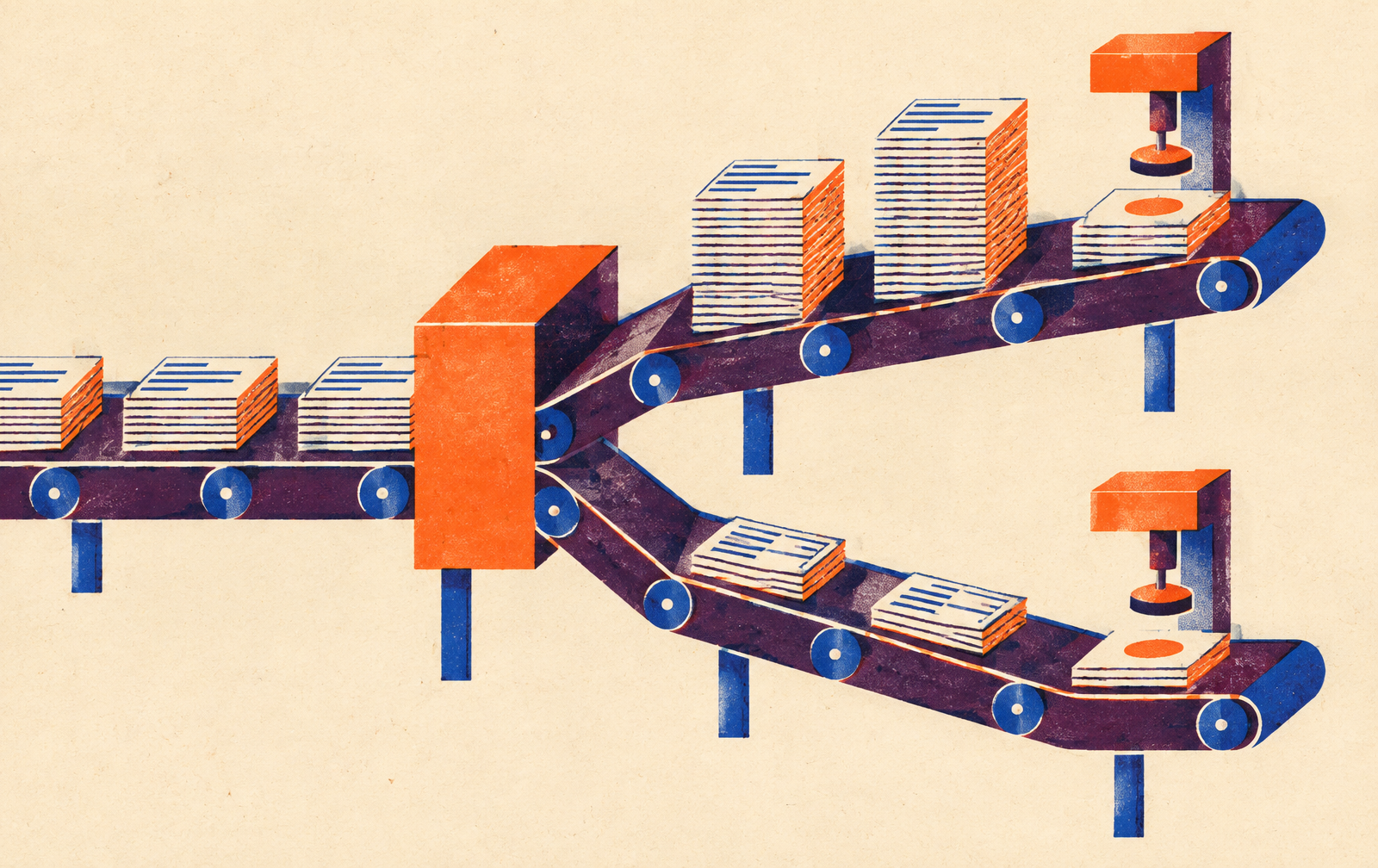
The first refreshed articles for a global endurance sports brand were excellent and took four hours each. With hundreds in the queue and five audience personas to serve, excellence was not the problem. Throughput was.
A global endurance sports brand had five well-defined audience personas, a backlog of several hundred articles, and a first batch of refreshed pieces that took four hours each to produce. The quality was right. The math was not.
This is how we designed a production line with Conductor's API and content profiles at its center, an in-house agentic system carrying the repeatable stages, and effort tiered by what each article type actually needed, and what we still cannot claim about the time savings.
The Problem: Good Work At An Impossible Rate
Six weeks into the engagement we timed ourselves. A refreshed article, done properly, was taking three and a half to four hours.
- Roughly 30 minutes in Conductor finding a viable keyword angle with competition the brand could actually win, and pivoting when the first choice was locked up by a magazine.
- An hour and a half to two hours on the outline, the draft, and the visuals.
- Thirty minutes of quality control: every claim checked, every number traced, every race name and distance verified against the house dictionary.
The output was good. The client's content lead was approving pieces with light edits, and the early traffic results were strong.
But the queue behind those pieces was several hundred articles deep, a second stream of net-new content was starting, and the client had made clear that the long-term goal was less of our time in the loop, not more. Four hours per article was a craft process. It was not a system. The first batch, and what it earned, is covered in reviving a dead content library.
Three constraints made it harder than a simple "go faster" problem. The brand had five distinct audience personas, from first-timers to elite competitors to destination-driven travelers, and the tone, terminology, and depth shift materially between them.
A training article for a nervous beginner and the same topic for a veteran read differently, and Conductor's content profiles were set up to reflect that, one profile per persona. The catch was that a single draft could only carry one profile, and plenty of articles served two audiences at once.
The second constraint was quota. Conductor's plan capped AI-assisted drafts at 60 per year. With a backlog this size, we would have exhausted that in the first quarter if every article consumed a slot.
The third was review bandwidth. There was one approver on the client side, she was also running a mobile app launch, and every hour we added to her review time was an hour the program could not afford. Whatever we designed had to reduce her load, not shift ours onto her.
What We Did And Why
Put The Platform In The Middle, Programmatically
The first decision was to stop using Conductor through its screens for the repeatable steps and start using it through its API.
Conductor exposes its briefs, scoring, and cannibalization checks programmatically, which meant our in-house agentic content system could call them as stages in a pipeline rather than waiting for a person to click through them.
- Semrush supplies the keyword and competition data.
- Conductor builds the brief and checks the target against existing pages for cannibalization.
- The agentic system drafts, scaffolds, and QCs.
- Conductor scores the result.
- A human reviews the flags and approves.
Each stage has a defined input and output, and the tracking sheet the whole team works from updates at each one. That pipeline is how we run discoverability work at volume.
This is the single change that made the rest possible. When the platform is a stage in a pipeline, you can run it 30 times overnight with the same rigor as once by hand. When it is a screen, you cannot.
Make Persona A Field, Not A Judgment Call
We rebuilt the intake so that every article enters the pipeline with a persona assigned, mapped directly to the Conductor content profile it should use. Where an article served two personas, we made the call explicit at intake rather than leaving it for the drafting stage to guess, and we picked the primary.
The agentic system's drafting and critique stages read the persona and adjust: vocabulary, assumed knowledge, the depth of the physiology, whether to explain a term or use it. The house-style dictionary carries persona-specific notes, so a term that is fine for elites and confusing for first-timers gets flagged when it shows up in a beginner piece.
That sounds small. It removed the most common reason a draft came back from the client: right facts, wrong reader.
Tier The Effort By What The Article Needs
Not every article deserves four hours, and we had been giving every article four hours. We split the backlog into two tiers.
- Technical pieces, meaning training plans, checklists, gear, and anything with numbers a reader will act on, keep the full treatment: heavy human oversight in QC, custom visuals, every claim traced.
- Softer pieces, meaning community stories, mindset, race-week psychology, and event culture, run through the pipeline with more platform-led drafting, lighter QC, and fewer or no custom images.
The client agreed to that split explicitly, which mattered, because it changed the review conversation from "why is this piece lighter" to "this is a tier-two piece and here is what tier two means."
Treat The Quota As A Constraint To Design Around
The 60-draft annual cap stopped being a blocker once we looked at how the slot was consumed. A draft holds its slot until it is cleared. So the pipeline publishes, clears the draft, and reuses the slot, which turns a hard annual ceiling into a rolling one.
It is a workaround, and we flagged the token and quota economics to the vendor and the client as something to revisit if the volume grows. But it meant the quota shaped the sequencing rather than the scope.
Keep One Sheet, One Approver, One Flow
The operational side is unglamorous and it is where most content programs actually fail.
- One central tracking sheet, visible to the client's editors, our team, and the vendor's success team, with a status column updated at each stage.
- One approver on the client side, receiving a flag list per article rather than a draft.
- One handoff format: a rewritten draft, a self-contained HTML preview, the schema block, and a change note, so the client's CMS editors paste and publish without a developer. That is the AI-to-CMS last mile in practice.
- Published dates set to the refresh date, not the original one from a decade ago, so the pages read as current to both people and engines.
The alternative we considered was scaling by adding writers. We rejected it because the four hours were not writing time. They were research, structure, verification, and formatting, and adding people to that multiplies coordination without removing the work.
What Changed
By late August the pipeline had produced 50 articles across both streams, with 45 refreshed pages live and the rest in the client's approval queue.
The live set was drawing more than 5,000 new users a week, and the most recent weekly report showed just over 10,000 organic sessions for the refreshed group, up 107 percent on the previous period. Nineteen of the first 21 pages published had been earning zero traffic for more than 18 months before the refresh. Every one of those figures comes out of the same measurement setup.
The operational numbers are the ones this piece is really about. The vendor's onboarding and implementation phase closed on schedule, with the client validating the work in the platform's own reporting.
The single approver moved from reading drafts to resolving flags. The tracking sheet became the shared source of truth for three organizations. And the persona field at intake removed the "right facts, wrong reader" rejection almost entirely from the review loop.
The honest edge. We are not going to claim a time-per-article number yet. The projection we gave the client, and still believe, is that per-article effort falls by roughly half once the system has enough of the brand's terminology, sources, and persona voice in memory to stop asking.
That is a projection. We measured four hours at the start and we have not run a clean re-measurement on a comparable batch since the tiering and the API integration went in. Any figure we quoted now would be an estimate dressed as a result, and this program has had enough of those from other tools.
Two other limits. The quota workaround is a workaround; if the client's volume grows, the honest conversation is about plan size, not about clever slot reuse. And the client's original expectation was a platform that would eventually run top-of-funnel content on its own. The production line reduces human time and concentrates it where it matters. It does not remove it, and on tier-one content we would not want it to, for the reasons set out in what an SEO platform cannot catch.
What You Can Take From This
Time one article end to end before you scale anything. Most content teams know their output per month and almost none know their hours per piece broken into stages.
The stage breakdown is what tells you where a system can help. In our case the writing was the smallest slice; research, structure, verification, and formatting were the bulk, and those are exactly the stages a platform API and an agentic pipeline can carry.
Then make every judgment call that repeats into a field at intake. Persona, tier, primary conversion, whether the piece touches a topic that needs a disclaimer: if a human has to decide it every time, decide it once at the front and let the pipeline read it. Half the review friction we removed came from moving decisions earlier, not from making the system smarter.
Use the platform's API, not its screens, for anything you will do more than 20 times. Conductor's briefs, scores, and cannibalization checks are all reachable programmatically, and a content platform that is a stage in your pipeline behaves completely differently from one that is a tab in your browser. If your platform cannot be called that way, that is a real evaluation criterion, not a nice-to-have.
And tier deliberately, in writing, with the client. Not every article deserves the full treatment, and a program that gives every piece four hours is a program that will never clear its backlog. The tiering conversation is uncomfortable for about ten minutes and then it is the thing that makes the whole plan credible.
If your content backlog is bigger than your team's hours, we would be glad to map your stages, time them with you, and show you which ones a production line around your platform could carry.
Bring this dispatch into a working session - one page in, scoping memo out.
Brief Foyer