
Multisite Drupal · Locally managed estates
Hundreds of sites, one platform,local teams still in control.
Consolidating a large, locally managed site estate onto Drupal is a governance problem before it is a design problem. We standardize the template set first, ship the governance model on day one, and prove launch throughput on a small batch before the full rollout commits.
A Drupal architect reads your situation and replies in writing, usually inside 24 hours. Read the sequencing below first, then book a call if it is useful.
How we sequence a consolidation: template set first, governance on day one, launch throughput proven on a small batch.
What we keep finding
Six patterns show up in almost every large, locally managed estate.
None of them are design problems. They are the reasons a platform replacement either holds for a decade or drifts apart within a year.
A template per site, by accident
Every batch of launches inherited whoever built them. Two sites that should be identical behave nothing alike.
Publishing that needs a ticket
Local teams have the content and the context, but not a way to ship it without technical help.
Shared content copied, never reused
The same menu, policy or brand block lives in hundreds of places, so it is never current in all of them.
Governance decided per team
No consistent roles, review states or audit trail. Who can publish what depends on who set the site up.
Thousands of components to move
Migration scope is counted in pages, then discovered in components. That is where estimates break.
Autonomy versus consolidation, unresolved
Local teams fear losing control. Left unanswered, that fear stalls the rollout long after the platform is ready.
The platform decision is usually the easy part. The hard part is whether several hundred local teams can work inside it on Monday morning.
Structure
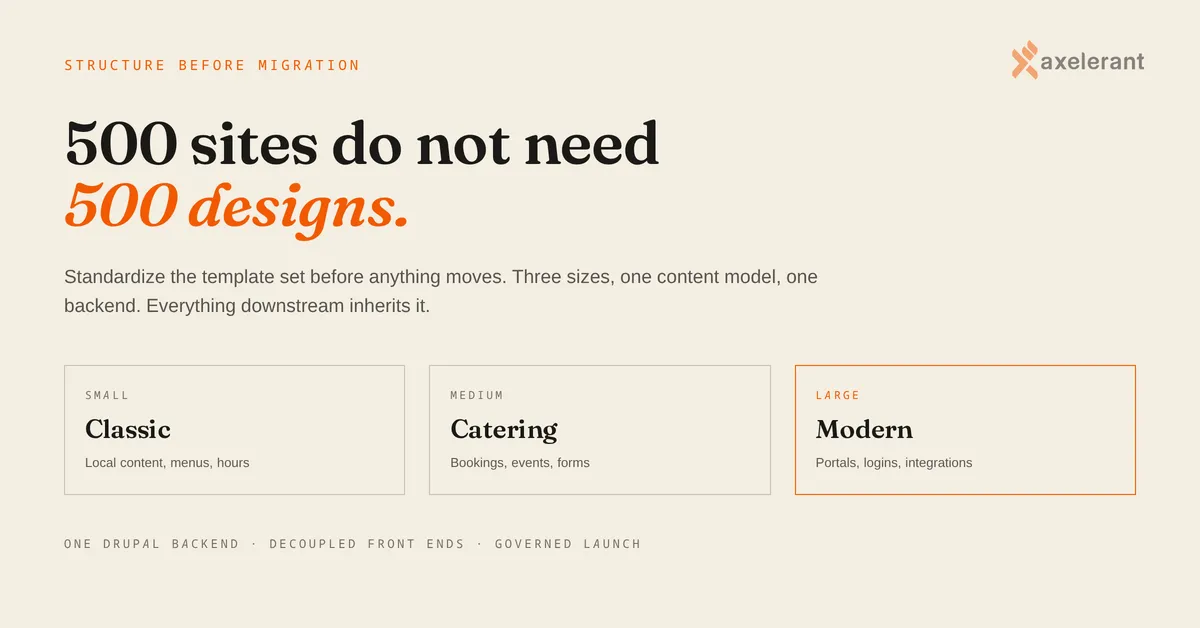
Standardize the template set before anything moves
Several hundred sites do not need several hundred designs. They need a small template set, agreed and sized before a single page is migrated: a light local template, a mid-weight template with bookings and forms, and a heavier one carrying portals, logins and integrations.
One content model and one Drupal backend sit underneath, with decoupled front ends per template. Everything downstream inherits that decision: the component library, the permissions model, the migration mapping, the QA gates.
- Template sizing derived from sites in your estate that already work
- One content model, shared content reused rather than copied
- Component library governed centrally, composed locally
Delivery risk
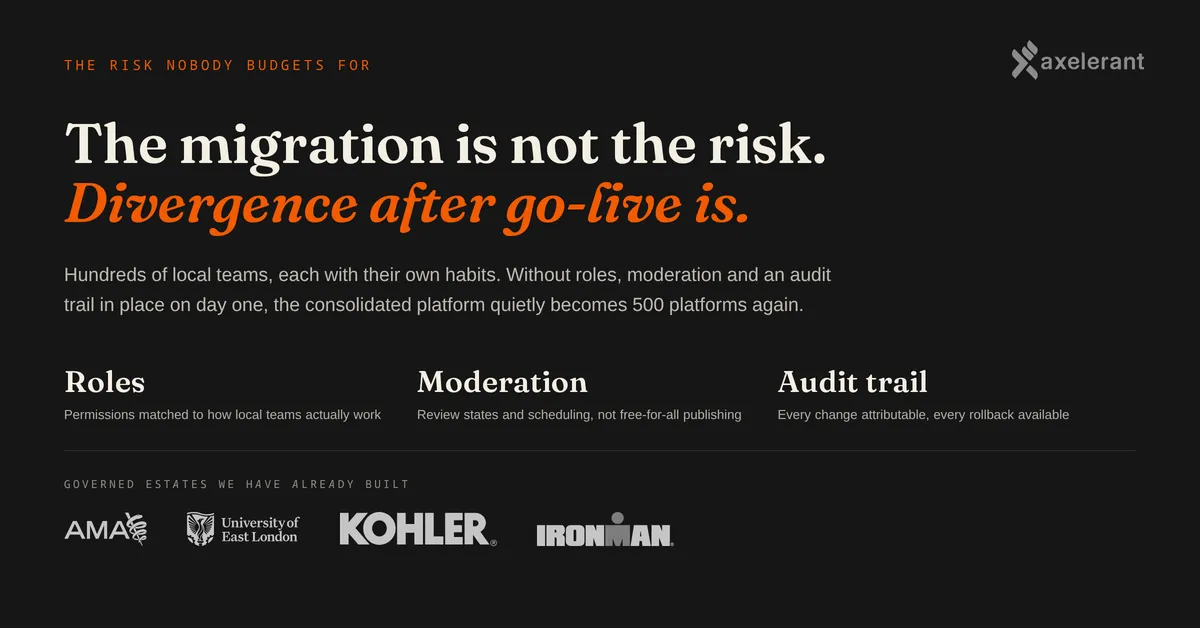
The migration is not the risk. Divergence after go-live is.
Consolidation programs rarely fail during the build. They fail two release cycles after go-live, when hundreds of local teams publish the way they always have and the single platform quietly becomes many platforms again.
So roles, content moderation, scheduling and an audit trail ship on day one, modeled on how local teams actually work rather than on an org chart. Autonomy is designed in deliberately: what a local editor may change, what is inherited, and what is locked.
- Role-based access matched to real local workflows
- Review states, scheduling and rollback, not free-for-all publishing
- Every change attributable through a complete audit trail
Launch throughput
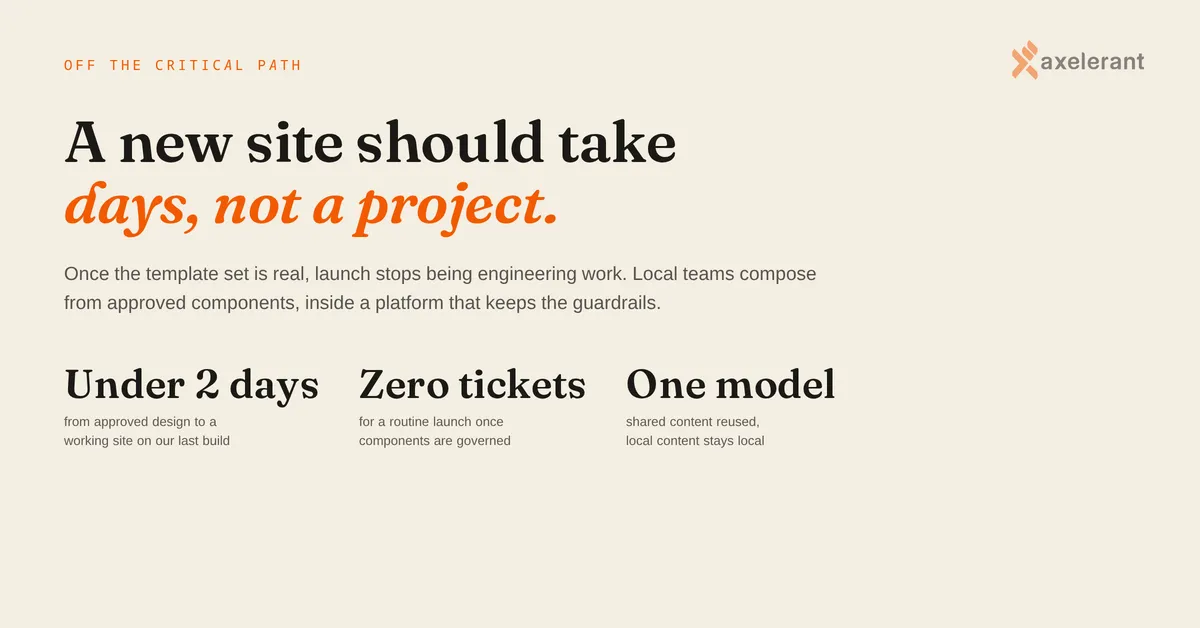
A new site should take days, not a project
Once the template set is real and components are governed, launching a site stops being engineering work. On our last consolidation of this shape, an approved design became a working site in under two days, composed by the team that owns the content.
This is the operational metric to hold an integrator to, because it is the one your teams feel every week after go-live. It also runs off the critical path, so it can be proven early on a small batch instead of promised at the end.
- Visual authoring your non-technical teams can use unaided
- Approved components only, so speed does not cost consistency
- Proven on a small batch before the full rollout commits
Architecture decision
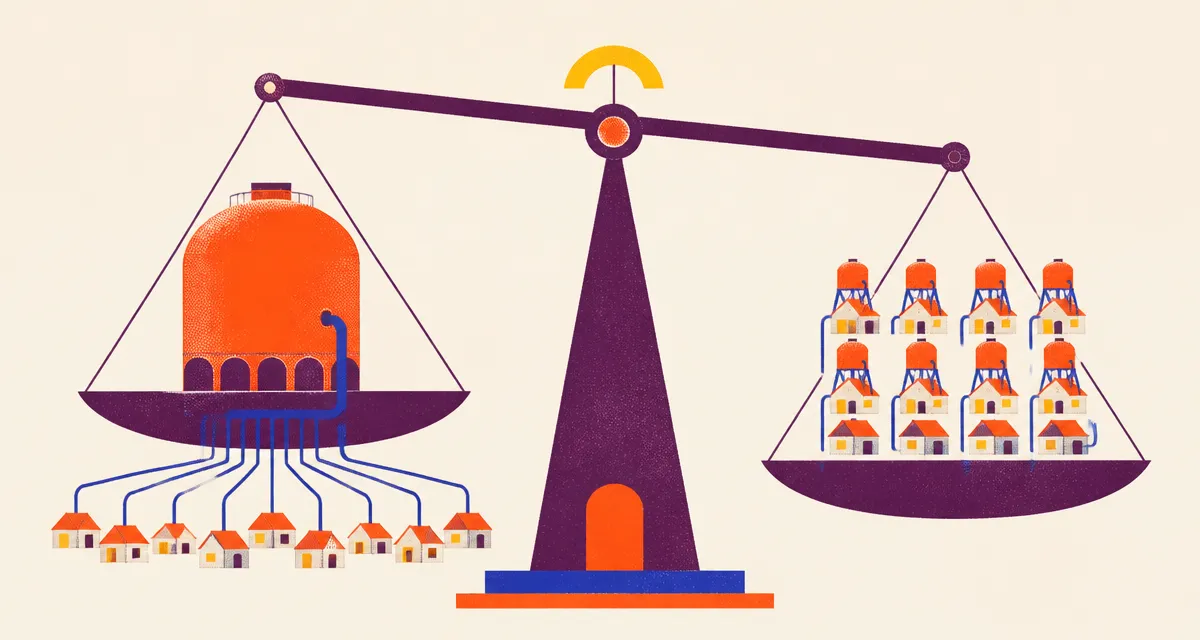
One database or many is a governance decision, not a preference
A single shared Drupal instance and database is simpler to run and cheaper to carry, and it lets shared content be genuinely shared. It also means one failure scope, one restore scope, and one release calendar for every site in the estate.
Separate databases, whether through Drupal multisite on a shared codebase or Acquia Multi-Experience Operations, buy real isolation per site or per group. The cost is provisioning work, cross-site reporting that has to be aggregated deliberately, and a higher operational floor.
We make that call with you on evidence: how independent the local release calendars really are, what regulatory or regional isolation you owe, and how much shared content there is. Then we write it down as a decision record, so the next team inherits the reasoning and not just the wiring.
- Shared instance, grouped databases, or per-site isolation, chosen against your release reality
- Blast radius, restore scope and release calendars named before the build
- Written architecture decision record you keep, with the tradeoffs we rejected

Editorial experience
Remove the technical dependency from everyday publishing
The reason local teams keep their own sites is rarely the design. It is that they can change something without filing a ticket. Consolidation only holds if the new platform gives them more of that, not less.
So the editorial layer is the product, not the finish. Approved components, in-browser composition, no theme code in the daily path. We work on Drupal Canvas and Experience Builder in the open, with a standing team on bugs, features and cleanup, because reducing the developer dependency inside Drupal itself is the same problem your marketing team has.
- In-browser page composition from a governed component set
- No theme or template code needed for routine editorial work
- Standing Axelerant team contributing to Drupal Canvas and Experience Builder

Adoption
Most of your local teams have never used Drupal. Plan for that.
We have taken teams with no Drupal background from a legacy proprietary CMS onto Drupal 11 and left them publishing unaided, including Energy Safety Canada, where editing had depended on developers and 1,000+ resources were effectively unfindable.
The starter is deliberately small: role-shaped sessions rather than a platform tour, a written playbook for the ten tasks each role actually does, office hours during the first two batches, and a retro that feeds the next cohort. Adoption is measured per batch, not declared at handover.
- Role-shaped onboarding for editors, approvers and site owners
- Task playbooks written against your own templates, not generic docs
- Office hours through the first batches, with a retro into the next cohort

Community
We fix this upstream, so you are not carrying a fork
Our Open Source Contribution Committee funds work back into Drupal, and we are a Drupal Association Certified Platinum Partner and a top-20 contributor worldwide. Practically, that means the authoring and governance gaps we hit on your estate get fixed in core and contrib where we can, not patched into a private branch you own forever.
It also means we write for the people who have to live with the platform. Non-technical adoption of Drupal is a subject we publish on, not a hope we hold.
- Fixes pushed upstream instead of into a private fork
- Platinum Drupal Association partner, top-20 contributor worldwide
- Long-standing Acquia partnership, including Multi-Experience Operations work
How we frame the work
Experience, Data, Activation, Optimization. Run as a loop, not a ladder.
We move the operational metrics inside each layer. Which of those matter to the business stays your hypothesis, not our claim.
Experience
The core of the workA sized template set drawn from your own estate, decoupled front ends per template, and visual authoring local teams can use without engineering help. Consistent patterns across every site, with local personality where it earns its place.
Data
StructuralOne content model across the estate. Shared content modeled as shared, site-specific content kept local, and structured operational data such as menus, hours and locations treated as data rather than as pages.
Activation
Governance firstRoles, moderation states, scheduling and audit trail defined with the teams who publish. Directory-driven access and single sign-on sequenced as their own phase rather than bolted onto the migration.
Optimization
Continuous, per batchSites migrate in batches, each with its own mapping, QA gate, redirect plan and completion record. Launch throughput, publishing time and support tickets are measured per batch, so the rollout gets faster with evidence behind it.
Credentials
Not new to Drupal. Not new to multisite at scale.
Teams who take their platform seriously






Proof · Estates we consolidated
Many local owners, one governed platform, content teams still shipping.
American Medical Association
Ten fragmented properties onto one governed Drupal platform
Campaign and resource sites scattered across platforms, taxonomy drift, accessibility debt and sensitive content. Audited across every property, migrated on deterministic pipelines, rebuilt on a reusable component model with real editorial workflows.
Fortune 200 group, named on request
Self-service multisite for 400+ operating companies
400+ operating companies, 90 countries, 110,000 employees. Local markets waited on engineering for every launch. We built portable, reusable configuration packages so markets ship their own sites inside a governed platform.
University of East London
Sitecore to Drupal, with the search experience rebuilt
Performance failures and no personalization layer. We migrated the estate, built advanced course search and a unified content hub, lifted applicant conversion 2.3x, and left the in-house team owning the design system.
Energy Safety Canada
A non-Drupal team onboarded onto Drupal 11 and publishing unaided
A proprietary legacy CMS where every edit needed a developer, 1,000+ safety resources nobody could find, and membership, learning and commerce sitting in separate systems. We rebuilt the public experience on Drupal 11, kept the systems of record in place behind it, and handed editorial control to a team with no prior Drupal background.
How a consolidation is sequenced
Foundation, then a proven pilot, then pace.
Template set and content model
We size the template set against sites already working in your estate, then settle one content model and the governance map with the teams who publish. Nothing migrates until this is agreed.
Weeks 1 to 4 · Foundation
Pilot batch, proven end to end
A small batch migrates, launches and gets measured: publishing time, launch effort, support tickets. The rollout plan is rebuilt on that evidence rather than on the original estimate.
Weeks 5 to 8 · Evidence
Rolling migration at pace
Batches ship continuously, each with its own mapping, QA gate, redirect plan and completion record you keep. Local teams are onboarded batch by batch, not all at once.
Continuous · Gated per batch
Our thinking on consolidation
Written from estates we already moved.
Read how we sequence a fleet, where governance breaks, and what we automate before a single site migrates.
Open a brief
Tell us the estate you are trying to consolidate.
A Drupal architect reads it, not an SDR. You get a written response, usually inside 24 hours, with how we would sequence the consolidation, where the governance risk sits, and what we would leave alone. If we are not the right team, we will say so and point you to one we trust.
- Written assessment first, a call only if you want one
- We will tell you what is not worth doing yet
- No sales sequences, unsubscribe anytime
Would rather talk it through? Book a candid call with a Drupal architect. Thirty minutes, no deck.