
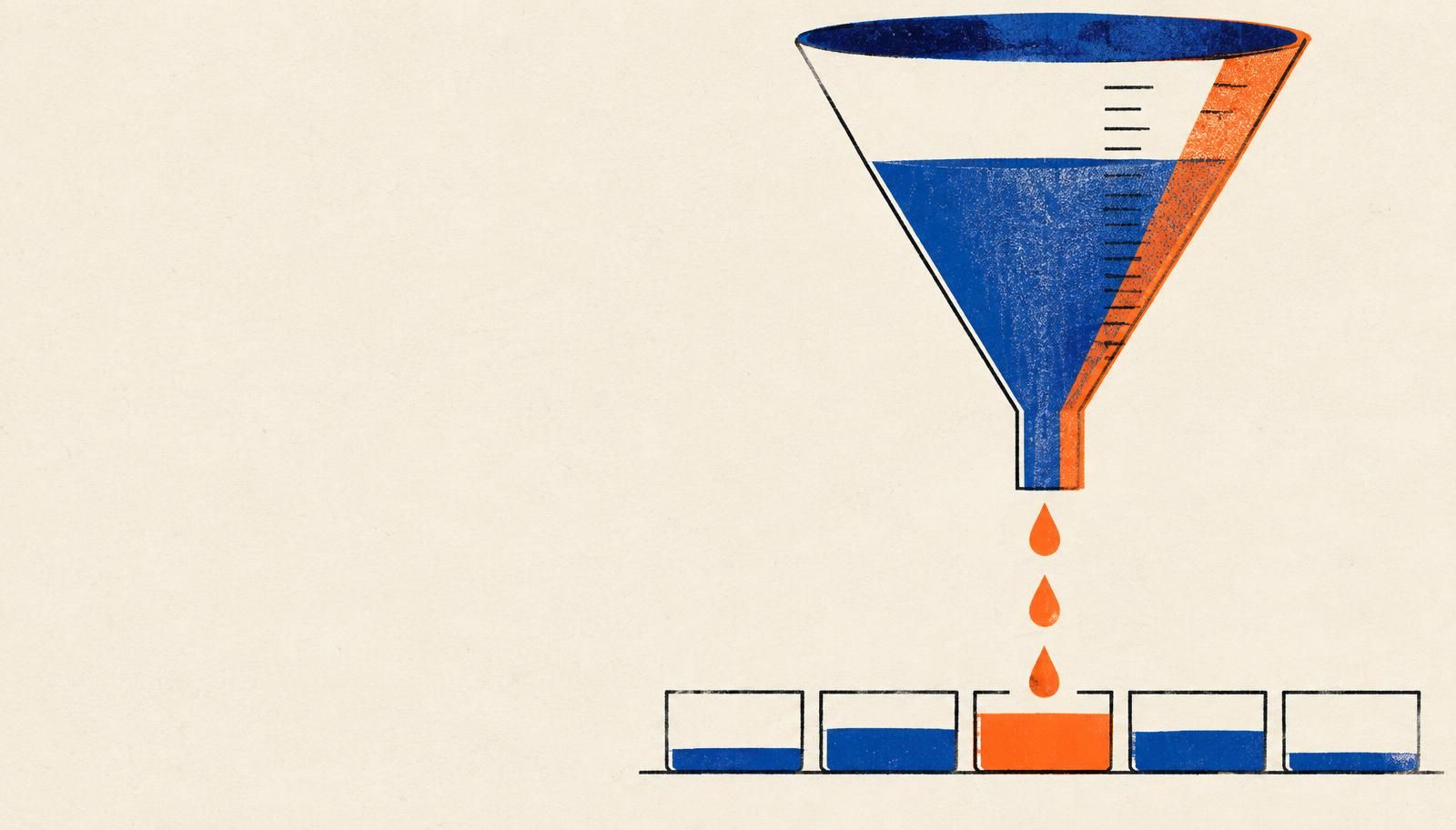
Stage six of eight. The question it answers: how does a visit become a qualified lead at the right location?
Ask a digital team for their conversion rate and they will have one. Ask them to draw the path from the pages a visitor lands on to the moment the business counts a lead, and the room goes quiet. There is a form. There is a number. What happens between the two is a set of assumptions.
Funnel and flow ambiguity always leads to loss. If nobody can draw the path from entry point to the endpoint that counts, nobody can find where it leaks, and every optimization is a guess dressed as a test. A manufacturer we spoke with recently had a conversion optimization team working incrementally for years, good people using good tools, and had never once reviewed the journey end to end. The tests were real. The funnel they were testing was undrawn.
Conversion funnel analysis, done as part of a redesign rather than after it, is the discipline of drawing that path, checking whether the site can actually see it, and agreeing with the people who hold the budget what the number is allowed to mean.
Draw the funnel forward and backward, per audience
A funnel drawn from the homepage down is the business's view of the journey. A funnel drawn from the conversion endpoint back up is the visitor's. They rarely match, and the gap between them is where the work is.
On a London university's site, the forward flow ran from the homepage through the programme pages to an application started and an application submitted. The reverse flow started at the apply endpoint and walked backward to find which pages actually fed it. Undergraduate and postgraduate journeys were separated from the first sketch, because they behave differently and a blended funnel hides both. The output was a flow diagram the whole organization could look at and argue with, which had not existed before.
For a multi-location business the funnel has a step most templates omit: the visitor has to reach the right location. A lead that lands at the wrong branch, or in a central queue that nobody owns, is a lead the site failed to convert. Draw that step. It is where "near me" discoverability hands off to conversion, and it is usually the least instrumented part of the path.
Check whether the site can see the path before you trust the number
Once the funnel is drawn, the next question is uncomfortable: which of those steps does the analytics actually record?
Most estates have gaps. A form start is tracked but the location selection is not. A programme page view is tracked but the download of the brochure that precedes the application is not. The number at the bottom is real; the story of how visitors got there is partly fiction.
On the university's project there was no systematic conversion tracking at all, so benchmarking was impossible until the gaps were closed. Worse, bot traffic was inflating the homepage, which made the site look busier at the top and leakier in the middle than it was. Stripping non-human traffic changed the shape of the funnel before a single design decision had been made. The honest baseline was smaller and far more useful.
The tracking-gap matrix is the artifact. One row per funnel step, four columns: what should be recorded, what is recorded, the gap, and who owns closing it. Fill it before drawing any conclusion from a conversion figure.
Give the people with the money scenarios, not a promise
Somebody approves the redesign budget, and they want a number. On the university project, the investor group behind the institution expected a hard conversion commitment before approving the build. Committing to one would have been dishonest, because the tracking gaps meant nobody could know.
The answer was scenarios. Three projections, labeled illustrative, showing what the funnel could deliver under a conservative, an expected, and a strong case, with the assumptions behind each written down. That went into a board package with three parts: the day-one targets the launch would be held to, a three-month post-launch optimization program with its own goals, and the scenario projections. The package existed to get the people with the money on board, in the team's words, and it did.
The principle generalizes. A single number commits you to a guess and teaches the board to distrust you when the guess misses. Three scenarios with visible assumptions commit you to a method, and when reality lands inside the range, the method earns credibility for the next ask.
Conversion fails for organizational reasons more often than technical ones
A CRO strategy assumes that once a leak is found, someone can fix it. That assumption is false more often than teams admit.
On a second UK university's estate, the conversion problems traced not to page design but to stakeholder alignment and page ownership. Layering more optimization methodology on top would not have resolved them, because the issue was approval, not capability. Tests could be designed. They could not be shipped.
The manufacturer's version is the branch network. Location pages have owners in the field, central pages have owners in marketing, and the form that joins them may have an owner in neither. Conversion funnel analysis has to include an ownership column, because the fix for a leak is worthless if nobody has the authority to deploy it.
Separate the funnels the redesign changes from the ones it doesn't
A conversion team is usually optimizing several funnels at once: a learning journey, a professional journey, a shop, a booking flow. A redesign changes some of them structurally and leaves others alone.
On a global certification body's program, the conversion baseline was built with separate views per funnel, learning, professional, shop, and travel, rather than one blended dashboard. That separation is what let the redesign's effect be seen at all: a structural change to the learning journey should show up in the learning funnel and nowhere else, and if it shows up everywhere, something other than the redesign moved.
For the internal optimization team this is the practical handshake. The redesign hands them a drawn funnel, closed tracking gaps, and a baseline per journey. They keep the incremental program running on the funnels the redesign did not touch, and they take over the redesigned ones once the structural change has landed.
The tools differ. The principles don't.
Every organization has its own analytics, its own heat-mapping, its own testing platform, and the team that knows them. A redesign should not replace that stack to prove a point.
What it should insist on is the sequence: set the goal, instrument it, test against it, report on it. The university used one heat-mapping tool; the manufacturer's team uses another; the principles are identical. Where traffic is choked off, the heat map shows it. Where a step is untracked, the matrix shows it. Where a change worked, the baseline shows it. The tooling is the client's. The discipline is the deliverable.
Lead routing is a conversion step
For a multi-location or multi-channel business, the funnel does not end at the form. It ends when the right person at the right location receives a qualified lead and acts on it. Everything between the form and that moment is conversion work the website is responsible for, and most redesigns treat it as somebody else's system.
The design questions are concrete. How does the site know which location a visitor belongs to, and what happens when it guesses wrong? What qualifies a lead before it is routed, and is that qualification visible to the visitor or hidden? When a location does not respond, does the lead die or escalate? None of these are CRM configuration. They are journey decisions, and they belong in stage six.
What the conversion stage hands over
- The funnel, drawn forward and backward, per audience, with the location or channel step included.
- The tracking-gap matrix, with owners, and the instrumentation plan to close it.
- The honest baseline, with non-human traffic removed and each funnel separated.
- The board package: day-one targets, a post-launch program, and labeled scenarios with assumptions.
- The ownership map: who can approve and deploy a change to each step.
- The lead routing logic as a journey decision, with the failure cases defined.
- The handshake with the internal optimization team: which funnels the redesign changes, which it leaves.
What breaks when the stage is skipped
The redesign launches on an undrawn funnel. Tests run on assumptions, and nobody can say whether the new structure helped.
The board gets one number. It misses, and every future ask is discounted.
Leaks are found and cannot be fixed, because the page belongs to someone who was never in the room.
Leads reach the wrong place. The site converted the visitor, the business did not, and the report says the website underperformed.
Where this sits in the sequence
Stage six inherits the two baselined numbers from stage one and the drawn journeys from stage three. It depends on stage five: a visitor who arrived at the wrong property or the wrong location is half lost before conversion begins. It hands the proof stage its measurement frame, and it runs continuously after launch alongside discoverability, which is where the internal conversion team already lives.
Questions we get asked about conversion funnel analysis
What is conversion funnel analysis?
Drawing the path from where visitors enter to the moment the business counts a conversion, checking which steps are actually tracked, and measuring where visitors drop between steps. Done forward from entry points and backward from the endpoint, per audience, so the business's assumed journey and the visitor's real one can be compared.
How do you build a CRO strategy for a website redesign?
Draw the funnel before designing anything, close the tracking gaps, establish a baseline per journey with non-human traffic removed, and agree with the budget holders what success looks like as scenarios rather than a single figure. Then hand the internal optimization team a structure worth testing rather than replacing their program.
What is lead routing, and why does it belong in the website funnel?
Lead routing is how a qualified lead reaches the right person or location. For a multi-location business the visit is not converted until that happens, so the routing logic, and its failure cases, are journey decisions the site owns, not CRM settings someone else owns.
How should you report conversion projections to a board?
As scenarios with visible assumptions, alongside the day-one targets the launch will be held to and the post-launch program that will move the number. A single committed figure is a guess; three labeled scenarios are a method the board can hold you to.
Read next in the series
The full sequence is set out in the pillar guide, Digital Brand Strategy: Eight Stages From Baseline To Proof. Each stage has its own article.
- Stage 01, the target. What are we trying to move, and where does it stand today?
- Stage 02, the audiences. How do we serve a second audience without breaking what works for the first?
- Stage 03, the journey. Where does someone fall out between interest and a conversation?
- Stage 04, the structure. What do we call things, and what varies across every local site?
- Stage 05, being found. Strong nationally, weak on near me. How do we fix that specifically?
- Stage 06, the conversion. How does a visit become a qualified lead at the right location? You are reading it.
- Stage 07, the system. How do we get a design system your own team keeps building with?
- Stage 08, the proof. How will we know, with data, that any of this worked?
- The personalization layer. What should adapt, for whom, based on which signal?
Bring this dispatch into a working session - one page in, scoping memo out.
Brief Foyer