
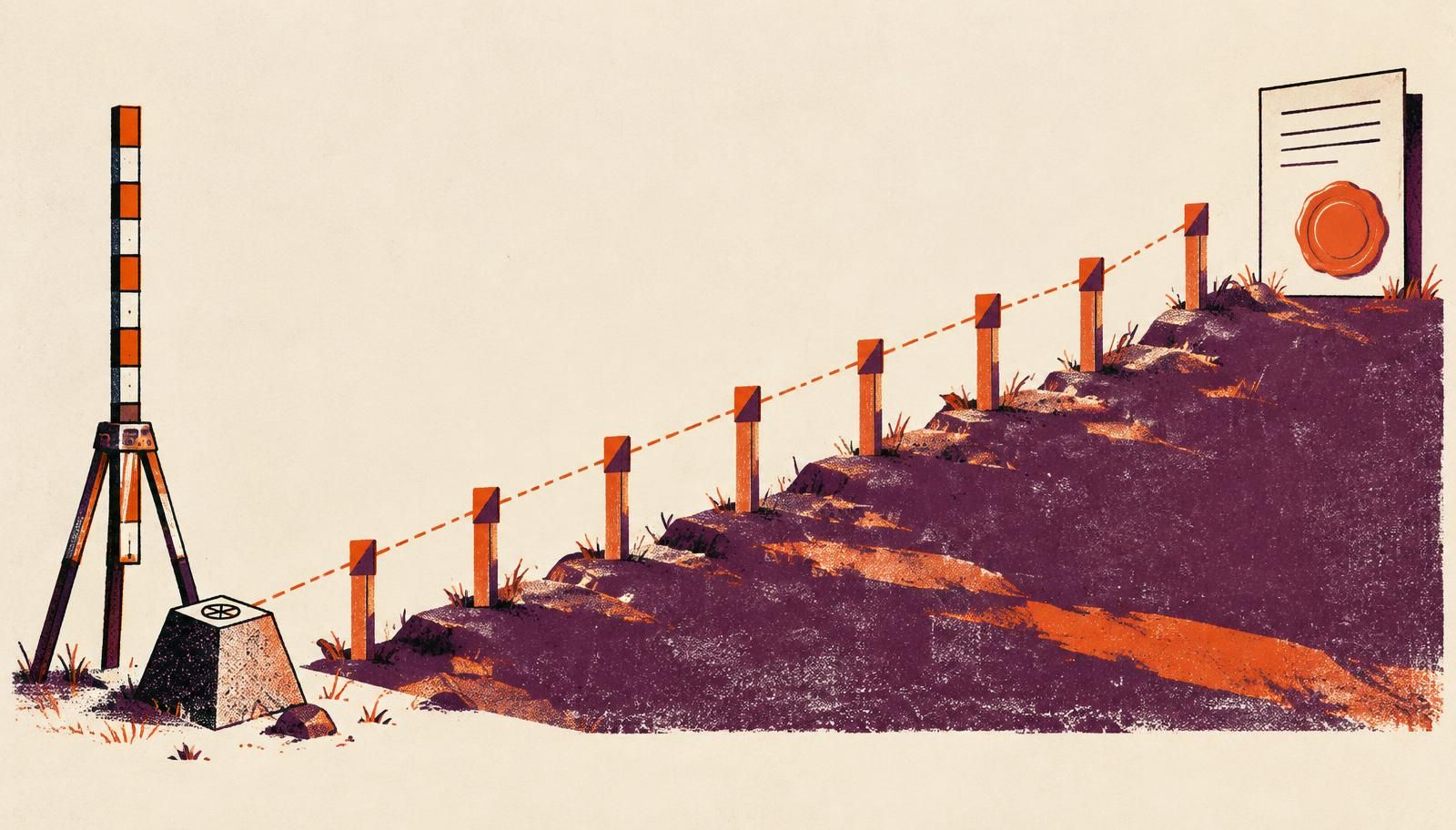
A redesign is not a design project. It is eight questions answered in sequence, with a baseline at the start and proof at the end. Skip one and you will find out which one in year two.
We have read a lot of corporate website redesign briefs this year. Different industries, different platforms, different reasons for reopening the process. The briefs are more alike than the companies are.
Somewhere in each one: the site drives a large share of the business, and leadership wants more.
- A second audience has been under-served and now matters.
- Navigation is organized the way the company is organized, not the way a buyer thinks.
- Search visibility is strong for the brand and weak for the problems the brand solves, or strong nationally and weak for "near me."
- Conversion is measured, but nobody trusts the number.
- The last agency left a design system nobody kept using.
- An internal team, usually good, usually stretched, has been improving things incrementally for years without anyone reviewing the journey end to end.
Then the brief asks for "a redesign."
The companies that end up disappointed are not the ones who chose the wrong agency. They are the ones without a digital brand strategy for the site, who let those eight questions get answered in whatever order the agency's process happened to run them. Design first, structure to fit the design, content to fit the structure, measurement bolted on at the end when someone asks whether it worked.
We run the same eight questions in a fixed order, and we spend most of the effort in the first four. That is where the decisions get made. When an agency slides into build while discovery is half done, both sides end up unhappy: unfinished thinking on one side, outputs that never arrive on the other.
The hard part of evaluating a redesign methodology is that it is sometimes hard to understand how the words apply in action. Fair. So each stage below is the question it answers, what the work looks like when it is done properly, and what breaks when it is skipped.
From brand intent to a working site: the website strategy, in order
01. The target. What are we trying to move, and where does it stand today?
There are usually two numbers hiding in this question. The total qualified leads the site sends to locations or sales, and the share of those coming from the audience you are trying to grow. Baseline them separately from day one. Otherwise, a year later, you cannot tell a genuine win from a shift in the mix.
Then check whether the current tracking can be trusted. On a London university project, the board wanted a conversion number they could hold the project to. We checked what the analytics actually recorded, field by field, and found bot traffic making the homepage look busier than it was.
The honest baseline was lower than the reported one and far more useful. Stage one is unglamorous. It is also the only reason stage eight can exist, and the reason a digital brand strategy is different from a website redesign project plan: the plan tells you when things happen, the strategy tells you what they are for.
02. The audiences. How do we serve a second audience without breaking what works for the first?
Almost every mature site has a primary audience it was built around and a secondary audience that has grown in importance. The temptation is to average them: one navigation, one tone, one journey, satisfying neither. It is a ranking decision, and the ranking changes how the research itself gets designed.
On a global certification body's site, one segment was the large majority of the audience and the other was the entire growth story. In research conducted with a partner, recruiting was different for each:
- Professionals through existing accounts.
- Prospective members through walk-ins at partner locations.
- A research vendor where a segment was hard to reach.
Inside the growth segment we found sub-segments with different reasons for hesitating, which meant the first content they saw had to differ. That is a decision you cannot make from a persona slide.
03. The journey. Where does someone fall out between interest and a conversation?
Journey mapping done top-down, from business intent, tells you what should happen. Done bottom-up, from analytics and heat-map behavior, it tells you what does. We do both, across every major entry point rather than just the homepage, and fuse them so each journey decision traces back to evidence.
The synthesis step matters as much as the research.
- Research surfaces loud ideas.
- Synthesis is where business realities get to argue with them, out loud, before anything is designed.
We sort findings into business, technology, and experience, and settle the debates there. On the certification body's project, prospective members wanted a low-barrier way to try the activity once; the business wanted to lead with the course that carried margin. That argument belonged in stage three, not as a surprise in stage seven.
04. The structure. What do we call things, and what varies across every local site?
Information architecture is not designed. It is derived. On the certification body's site, per-persona card sorting and tree testing ran in parallel with taxonomy and content modeling, each informing the other.
The clusters that came out of the card sort became the first menu prototypes, backed by two other views: the structure as it stood, and the structure search data wanted. The marketing team pushed back on renaming links that were performing well, and they were right to.
That is what redesigning a website without losing SEO actually looks like in practice: the search view sits beside the user view from the first menu prototype, not as an audit after launch. The menu that shipped came from that argument, not from a whiteboard.
The most common structure failure is a taxonomy built around how the company organizes its products rather than how a buyer explores a problem. We have seen product catalogs published as websites where the labels might as well have been product codes. Nobody shops that way, and nobody searches that way.
- On an endurance sports brand's site, their own team put it plainly: nobody would think to look in "news" for how to train for their first event, yet that is where the training content lived. Separating intent-led content from discovery-led content, with a three-level taxonomy and experience-level tagging, was a structure decision, not a design one.
- For multi-location brands there is a second structure problem: what is global, what is local, and what each location is allowed to change. Dozens of branch or regional sites under one domain need a content schema and a governance model before they need a template. This is the stage that stops them drifting apart.
05. Being found. Strong nationally, weak on "near me." How do we fix that specifically?
An SEO website redesign is usually scoped as "don't lose rankings." That is the floor, not the goal. National and local discoverability are different problems with different fixes, and lumping them into "SEO" is how both stay unsolved.
Before pulling any data, scope the audit: what does the business actually need to be found for, ranked by relevance rather than by volume, including how the brand shows up in AI answers. Then audit. Running reports first and deciding what matters afterward produces a list of keywords disconnected from anyone searching, converting, or buying.
- On the certification body's estate, several properties were competing with each other for the same searches, so the first deliverable was a keyword-ownership map deciding which site answers which question.
- On the endurance brand, AI assistants answered every question about the events and none about how to train for them, so we scored visibility in AI answers topic by topic across the major AI search surfaces and counted the missing content rather than estimating it.
There is also a reactive side to this stage that briefs never mention: when something breaks after a relaunch and a competitor starts outranking you, someone has to see it and route the fix into a sprint, not a chat thread.
06. The conversion. How does a visit become a qualified lead at the right location?
Funnel and flow ambiguity always leads to loss. If nobody can draw the path from entry point to the endpoint that counts, nobody can find where it leaks.
For the university, we drew the flow from homepage through course page to application started and application submitted, built a tracking-gap matrix field by field, and gave the board three scenarios instead of one invented number. That plan existed to get the people with the money on board, and it did.
The analytics tools differ from client to client. The principles do not: set the goal, instrument it, test against it, report on it. For a multi-location business the extra step is routing. A lead that reaches the wrong branch is a lead the site failed to convert.
07. The system. How do we get a design system your own team keeps building with?
Direction first, fidelity second. Moodboards for hero treatment, tone, and imagery before a single screen, as a check that the direction is right. Then wireframe structures per persona journey, so layout decisions trace back to research. Then grayscale wireframes, where content constraints get argued. Then two candidate hi-fi directions to react to, and convergence.
Brand constraints are real and specific. On the certification body's project, new typefaces were allowed; the colors and the logo were not, after decades in market. The client had its own design team and did not want to return to a vendor for every small change, so the output was a component library in Figma and Storybook, with variants and governance, so the internal team keeps building with it after the agency leaves.
Being honest: we have got this stage wrong ourselves. On the same project, we jumped to hi-fi wireframes before the rationale for content hierarchy and navigation was agreed. Feedback stalled because nobody could evaluate a finished screen against a structure that had not been decided. We went back to user flows and lo-fi wireframes with the reasoning written down. The stage order exists because we have paid for skipping it.
08. The proof. How will we know, with data, that any of this worked?
Stage eight only works if stage one happened. The baseline set at the start is validated at the end: A/B tests against the specific journeys the redesign was meant to change, usability testing against the tasks that mattered, heat-map review of the pages that were rebuilt.
Every business measures success differently, which is why the measures are agreed in stage one rather than discovered in stage eight. A result that validates resets the target, and the sequence starts again with a better baseline.
Eight stages run once. Two of them never stop.
The stages are drawn as a line because they are one. You do not re-run persona research, card sorting, or design-system foundations every quarter. That work is structural. It is most of what a website revamp actually is.
Two things on the line are different.
- Being found and the conversion are programs, not phases. They keep running after launch, and they are where an internal SEO or CRO team already lives.
- A redesign done in the right order hands them a structure and a baseline worth optimizing, rather than replacing them.
And the whole line closes into a loop: proof feeds target. The second pass through the eight stages is faster and cheaper than the first because stages two through four and seven are already done. What remains is the two continuous programs and a validated target.
Personalization is a layer, not a stage
Personalization comes up in every brief and belongs in none of the eight boxes. It sits on top of being found, the conversion, and the system: what should adapt, for whom, based on which signal.
The framework we use has six parts: foundations, which set the principles and the intent signals, explicit and implicit; a model with three layers plus real-time activation, from behavior-backed to data-backed to journey-backed through a customer data platform, with AI-driven next best action on top; application logic; a use-case library; data and systems; and a roadmap.
The first two layers of the model need no new infrastructure, and that is usually where the first year's value is. It gets its own write-up in this series. The reason it is a layer is simple: personalizing a journey that has not been structured, found, or measured personalizes the wrong thing faster.
The website redesign checklist is the eight questions
Read your current brief against the eight questions. The one you cannot answer yet is the stage you are about to skip. If the answer to "what are we trying to move" is a feeling rather than two separately baselined numbers, no amount of design quality downstream will save the proof stage.
If structure is being decided by whoever designs the homepage, the taxonomy will describe the company, not the customer. If discoverability and conversion are scoped as a final phase, they will be the first things cut.
The stages can be run separately. Discovery and strategy through stage four is a self-contained engagement; build and grow can follow with the same team or a different one. Not every stage carries the same weight for every organization; the volume of the transformation decides that.
What cannot change in a digital brand strategy is the order the decisions are made in. It is the same argument we make about sequencing delivery: the order of the decisions sets the ceiling on the result.
Questions we get asked about the website redesign process
What is a digital brand strategy, and how is it different from a website redesign?
A digital brand strategy decides what the brand's primary channel is for, who it must serve first, and how success will be proven. A website redesign is one way of executing it. Run the redesign without the strategy and you get a better-looking version of the same decisions.
How long does a website redesign take?
Discovery and strategy through the structure stage is a self-contained phase and typically the shortest. Build depends on the size of the estate and how much of the design system already exists. The honest answer is that the schedule is set by stage four: once the structure is validated, everything downstream can be estimated; before that, any timeline is a guess.
How do you redesign a website without losing SEO?
Carry the search view through the structure stage rather than auditing afterward. The as-is IA and the SEO IA sit beside the user-tested IA from the first menu prototype, so performing pages and links are protected by design. Then treat discoverability as a program that starts before launch and continues after it, with someone watching for breakage.
What is the difference between a website redesign strategy and a website redesign project plan?
The plan sequences work and dates. The strategy decides what the work is for, in what order the decisions get made, and how the result will be proven. A plan without a strategy delivers on time and cannot say whether it worked.
Read your own brief against the eight questions
If you want a second pair of eyes on which stage your brief cannot yet answer, we are glad to think it through with you. Start with our strategy practices, or see the sequence at work in how Energy Safety Canada modernized its member experience and in the digital experience of The Ironman Group. Then bring us your brief.
Bring this dispatch into a working session - one page in, scoping memo out.
Brief Foyer