
Introduction
The most transformative shifts in delivery leadership rarely come from new tools or frameworks — they emerge from a change in mindset. The Forward Deployment Readiness Program (FDRP) at Axelerant is one such shift.
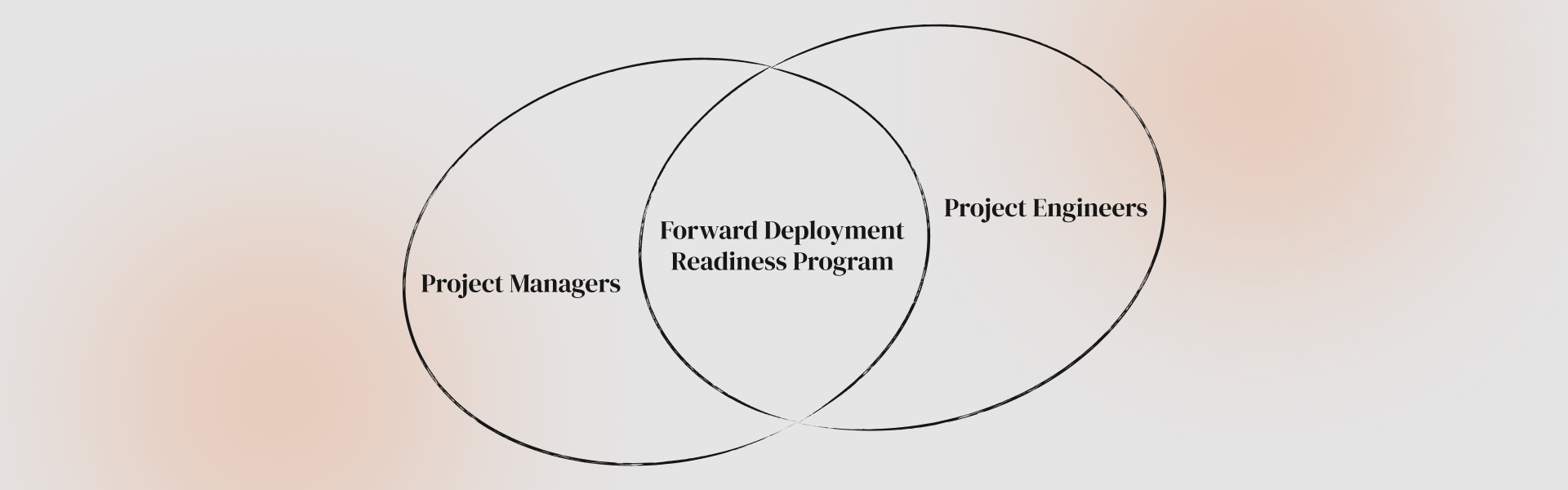
Built around a structured series of hands-on workshops, the program helps Project Managers operate closer to the client’s business outcomes — not as executors of scope, but as strategic contributors to value.
The idea behind forward deployment is not just to get closer to the customer, it’s to get closer to the value we’re creating. When delivery teams see the business context, their decisions become sharper, their solutions more relevant.
— Hetal Mistry, Director of Delivery, Axelerant
Why Forward Deployment, Why Now
Delivery has evolved beyond process management. Clients no longer measure success by sprint velocity or ticket closure rates — they look for partners who understand their business models, anticipate their needs, and guide them toward measurable impact.
The Forward Deployment approach was created to meet this expectation. It borrows from the “forward-deployed” model popularized by technology-first organizations like Palantir, but reimagines it for digital delivery contexts — blending technical fluency, business acumen, and relational intelligence.
For Axelerant, this model aligns directly with its commitment to being an AI-first organization — where people, processes, and tools are continuously augmented by intelligence. By enabling delivery leaders to connect context, data, and empathy, FDRP ensures that readiness isn’t just about skills, but about strategic awareness.
Forward deployment isn’t about proximity to the client — it’s about proximity to purpose.
— Hetal Mistry, Director of Delivery, Axelerant
From Selling To Solving
One of the most transformative moments in the workshops was reframing what it means to influence. Drawing from Daniel Pink’s book To Sell Is Human, participants explored the art of non-sales selling — where persuasion isn’t about convincing, but helping others make better decisions.
Instead of presenting deliverables, teams learned to:
- Spot unarticulated needs — going beyond the brief to identify value gaps.
- Frame “irrational questions” that unlock emotional motivators behind business goals.
- Translate solutions into human stories, not technical specifications.
Nikita Jain, reflecting on her learnings, shared:
“This book is really helping me rethink what sales truly means — it’s less about selling a product, and more about understanding people, perspective, and connection.”
Exercises pushed participants to craft narratives where project outcomes are experienced, not explained — where empathy drives influence.
This shift from transactional engagement to transformational understanding redefines what it means to lead delivery in an AI-augmented world.
Standing Beside The Buyer
The second pillar of the program focused on buyer-centric fluency — the ability to stand beside the customer, sharing their view of success.
Through structured roleplays and simulated account reviews, participants practiced five key behaviors:
- Context immersion — decoding client industries, stakeholders, and decision loops.
- Precision engagement — using insight-led questions instead of generic discovery templates.
- Co-creation over delegation — building project roadmaps as shared visual artifacts, not statements of work.
- Business-value anchoring — reframing delivery metrics into impact narratives (e.g., “uptime → reliability → customer retention”).
- Guiding internal navigation — coaching clients through their own change resistance and complexity.
Each behavior reinforced a core FDRP principle: influence isn’t positional — it’s relational.
Solving Through Service
The workshop series introduced a behavioral lens on service as strategic influence. Participants mapped different buyer personas — from visionary Executives to analytical Tacticians — and learned how each interprets credibility and value differently.
Rather than following rigid sales frameworks, participants practiced adapting their tone, pacing, and framing to match context. This approach helped redefine influence as responsiveness — meeting others where they are, not where we want them to be.
Sivagami captured this well in her reflection:
“Ambiverts can find that balance — they know when to speak up and when to step back. As PMs, that’s the trait that helps us connect meaningfully with clients.”
This balance of confidence and listening became the emotional core of the program.
The Mindset Shift
Every module circled back to a single idea — behavioral elasticity. The ability to flex between technical, strategic, and human modes is what defines forward-deployed leaders.
Workshops ended with guided self-reflections — prompts like “What assumption are you ready to let go of?” and “What one behavior will make you easier to trust?”
For many, this reflection was an inflection point.
It wasn’t about new KPIs. It was about rethinking identity — seeing oneself not just as a Project Manager, but as a context architect — shaping clarity in every direction.
“Adoption is what makes any change or transformation truly effective,” said Sivagami. “Without it, we keep changing things without seeing meaningful outcomes.”
That’s the mindset Axelerant is cultivating — where learning leads to adoption, and adoption leads to transformation.
Bridging AI, Data, And Delivery
Throughout the workshops, AI was not an abstract concept — it was embedded into daily practice. Participants explored tools such as NotebookLM, ChatGPT, and internal AI summarizers to simulate client brief interpretation, generate project hypotheses, and analyze engagement data.
By integrating AI into the learning loop, the program achieved two outcomes:
- It reduced cognitive load by automating repetitive synthesis tasks.
- It elevated decision-making by providing real-time contextual intelligence.
This reflects Axelerant’s broader mission: equipping every team member with AI-augmented clarity and autonomy.
Why This Matters
The Forward Deployment Readiness Program is a foundational step in building contextual leadership at scale.
It transforms delivery from an operational discipline into a strategic capability.
When Project Managers understand the business context, align with measurable outcomes, and use AI tools responsibly, they become partners in progress — not vendors in waiting.
That’s what readiness means at Axelerant: being able to anticipate, adapt, and act with purpose.
We’ve spent years perfecting how we deliver. Now, we’re perfecting why.
— Hetal Mistry, Director of Delivery, Axelerant
Closing Thought
Readiness isn’t a milestone. It’s a muscle.
And through the Forward Deployment Program, Axelerant is training that muscle — across every team, engagement, and interaction.
When purpose, empathy, and intelligence converge, delivery becomes more than execution. It becomes a transformation.
Bring this dispatch into a working session - one page in, scoping memo out.
Brief Foyer