
Health and nonprofit publishing
Inventory before design.Then relaunch without losing reach.
When your content is health information, the site is a publishing system, not a design project. We rebuild condition-information estates so the same answer stops living in four places, the traffic you spent a decade earning survives launch, and the content is structured well enough for an answer engine to cite it.
A content architect reads your situation and replies in writing, usually inside 24 hours. No calendar to juggle.
How we sequence a relaunch: inventory first, search equity protected, content structured to be found.
What audits keep finding
Six patterns show up in almost every mission-content estate we look at.
UX, SEO and accessibility audits tend to arrive separately and converge on the same structural causes. None of them are design problems.
The same answer in four places
A decade of well-meant pages means several versions of one explanation. None of them is canonical, so search picks whichever it likes.
Navigation built for the org chart
Programs, advocacy and education became top-level nav. A caregiver arrives with a question and a fear, not a department name.
One site, five very different audiences
Patients, clinicians, policymakers, donors and media all land on the same page and all leave underserved.
Clinical content with no provenance
No reviewer, no review date, no citation trail. Readers cannot tell it is current and neither can a machine.
Registrations and giving bolted on
Course sign-ups and donation journeys live in separate tools with separate designs, so drop-off is invisible.
Accessibility handled per page
Contrast, headings and alt text were fixed wherever someone complained. Nothing in the templates stops it recurring.
The diagnosis is usually already done. The gap is execution capacity that can move at pace without breaking what people already find.
Structure
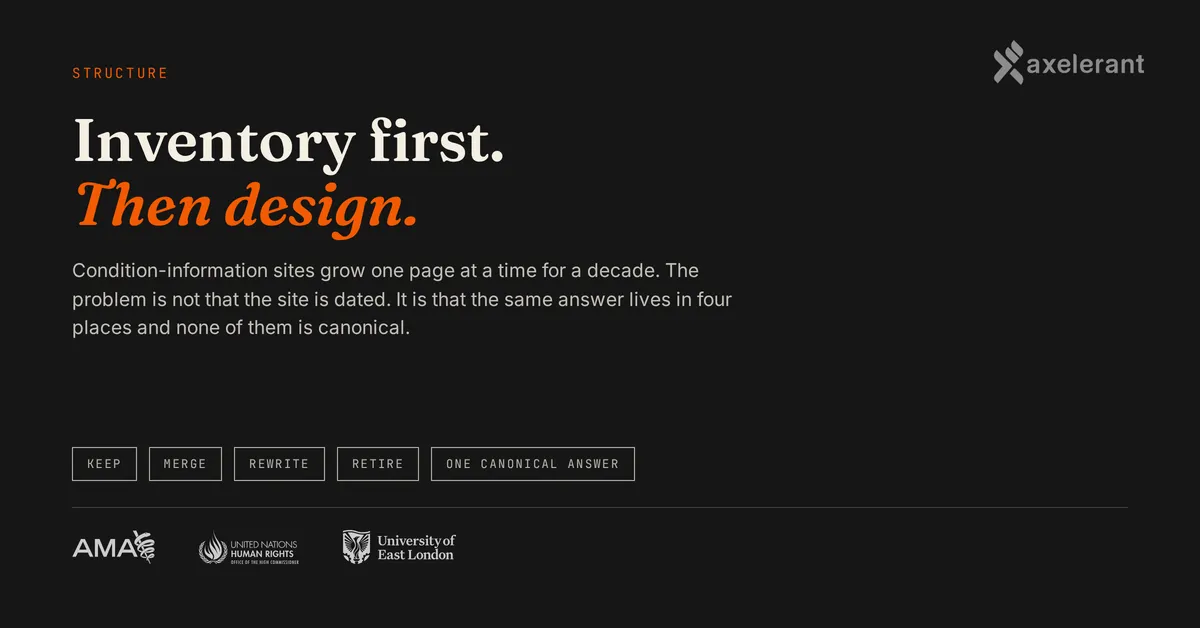
Inventory before design
A new visual layer does not make you the trusted source. Structure does. Navigation, taxonomy and URL design are the infrastructure every template, every metadata field and every piece of structured data inherits.
So we inventory first. Every page classified: keep, merge, rewrite, retire. One canonical answer per question. One taxonomy that a patient, a clinician, a policymaker and a donor can each travel without meeting each other's content.
- Full page inventory as a dataset your team keeps after launch
- Audience-led navigation, built on the questions people actually search
- Duplicate explanations consolidated into one canonical page
Launch risk
Relaunch without deleting your reach
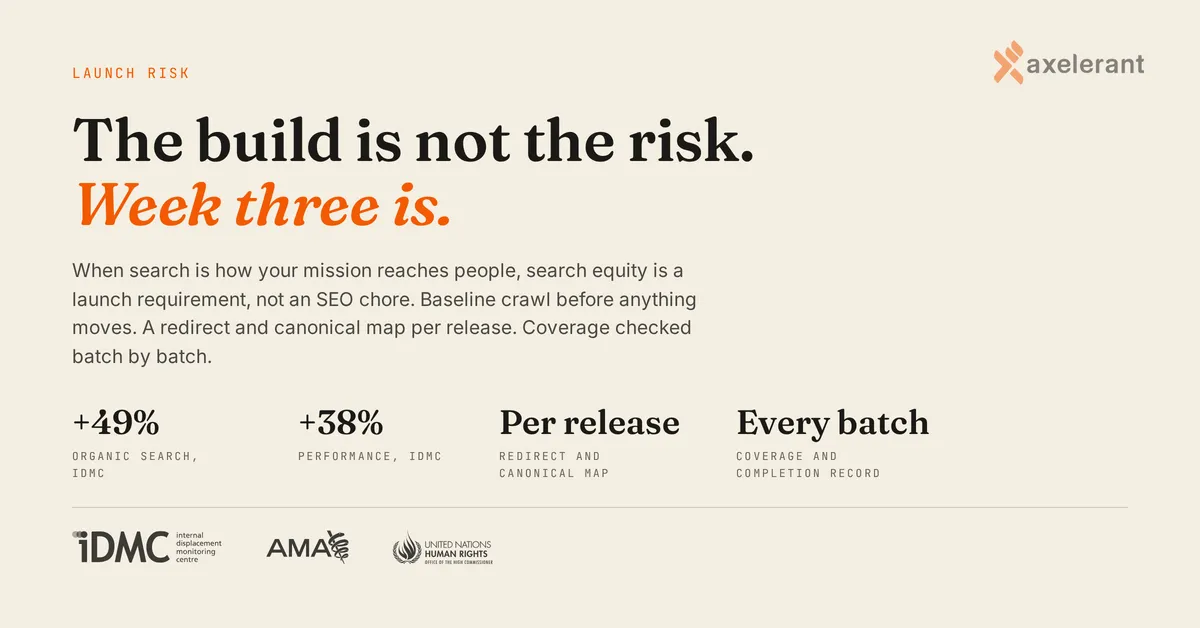
The expensive failure in a relaunch is not the build. It is week three, when pages people have been finding for ten years return an error and nobody can explain the drop.
When search is how your mission reaches people, search equity is a launch requirement rather than an SEO chore. We baseline the crawl before anything moves, then release in batches, each with its own redirect map, canonical decisions, sitemap submission and coverage check.
- Baseline crawl and duplication map before the first page moves
- Redirect and canonical plan per release, not one sweep at the end
- Coverage monitoring and a completion record for every batch
Discoverability
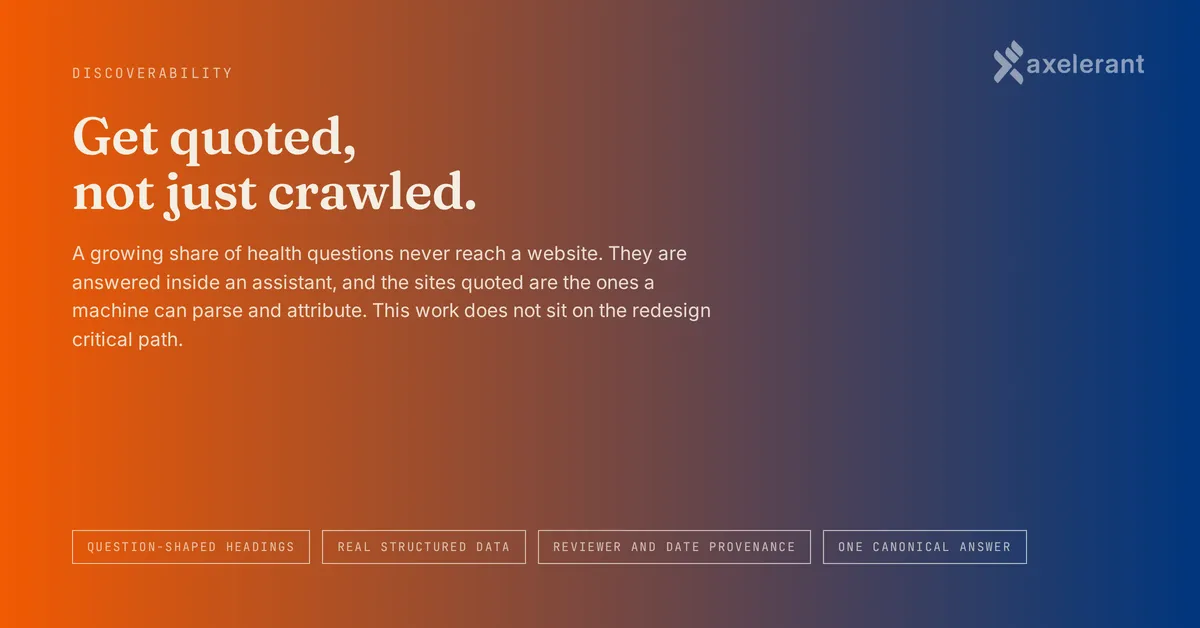
Get quoted, not just crawled
A growing share of health questions never reach a website. They are answered inside an assistant, and the sources quoted are the ones a machine can parse and attribute.
That work sits off the redesign critical path and can start immediately. Question-shaped headings, real structured data, reviewer and date provenance on every clinical page, and one canonical answer per question rather than five competing ones.
- Question-shaped content model, applied by template rather than by author
- Structured data and provenance fields inherited by every page
- A measurement baseline for citations, not just sessions
How we frame the work
Experience, Data, Activation, Optimization. Run as a loop, not a ladder.
We move the operational metrics inside each layer. Which of those matter to the mission stays your hypothesis, not our claim.
Experience
The core of the workAudience-led navigation for patients, caregivers, clinicians, policymakers, donors and media. A small set of flexible templates instead of a bespoke page pattern per program. Accessibility built into the components, so it stops being a per-page rescue.
Data
StructuralOne taxonomy across conditions, audiences and programs. A full content inventory as the spine, with keep, merge, rewrite and retire decisions attached. Reviewer, review date and citation fields on clinical content, inherited as structured data.
Activation
Journey workRegistration and giving journeys treated as first-class paths, instrumented end to end so drop-off is visible. Newsletter, event and course capture consistent across the estate rather than dependent on whoever built the page.
Optimization
Continuous, per releaseRedirect and canonical consolidation, sitemap submission, coverage monitoring and answer-engine citation checks as each batch ships. A go-live record per batch that accumulates into evidence rather than a final invoice.
Credentials
Not new to Drupal. Not new to health content at scale.
Teams whose content has to be right






Proof · Mission content we have rebuilt
Fragmented estates, governed platforms, in-house teams still in control.
American Medical Association
Ten fragmented properties onto one governed Drupal platform
Campaign and resource sites scattered across platforms, taxonomy drift, accessibility debt and sensitive health content. Content audited across all of them, migrated on deterministic pipelines, rebuilt on a reusable component model with real editorial workflows.
OHCHR, United Nations
Human rights publishing at global scale
Mission content in many languages, high scrutiny, permanent archives. A publishing platform an in-house team runs without engineering standing behind every update.
IDMC
Organic search up 49%, performance up 38%
A research and data organization whose reach depends on being found. Structure, metadata and performance treated as one problem rather than three separate audits.
Our thinking, and the work behind it
Written from estates we already moved.
How a relaunch is sequenced
Small batches, gated releases, an evidence trail you keep.
Inventory and content decisions
Every page classified, duplicate explanations identified, one taxonomy agreed across audiences. This is what makes the design work fast rather than speculative.
Weeks 1 to 4 · Ends in decisions, not a deck
Templates from the pages that already work
We take the page patterns in your estate that already perform and turn them into a small set of accessible, structured templates, built on a content model your editors can hold.
Weeks 3 to 8 · Design and build foundation
Batched release with equity protected
Sections ship in batches. Each batch carries its own migration, QA gate, redirect map, canonical decisions and coverage check, with a completion record you keep.
Continuous · Gated per batch
Answer-engine work in parallel
Off the critical path, provenance fields and question-shaped structure roll out across clinical content, with a citation baseline recorded before launch so improvement is provable.
Parallel stream · Starts early
Open a brief
Tell us the estate you are trying to fix.
A content architect reads it, not an SDR. You get a written response, usually inside 24 hours, with how we would sequence the relaunch, where the search-equity risk sits, and what we would leave alone. If we are not the right team, we will say so and point you to one we trust.
- Written assessment, no calendar bookings
- We will tell you what is not worth doing yet
- No sales sequences, unsubscribe anytime