
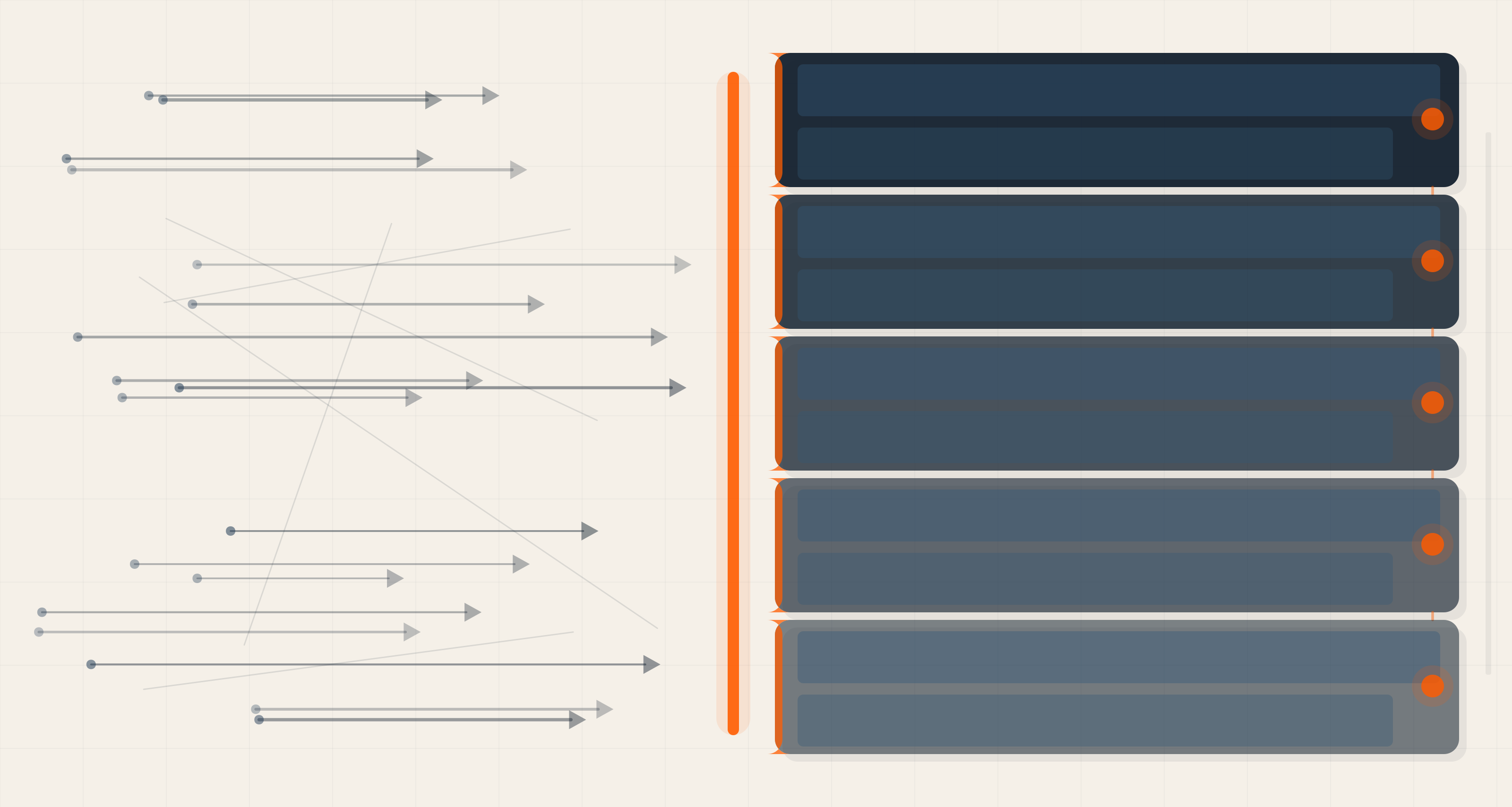
When every lifecycle moment has its own journey and none of them know about each other, you don't have a marketing strategy. You have a pipeline of noise. Here's what proper B2C journey architecture looks like in Salesforce Marketing Cloud.
The Problem With "35 Journeys"
When we first mapped the Marketing Cloud environment for a global sports and lifestyle brand, we found approximately 35 active B2C journey categories. On paper, that sounds like sophistication — a journey for every moment in the customer lifecycle.
In practice, it was the opposite.
The 35 journeys had been built incrementally over time, each created for a specific campaign or lifecycle event by different people at different moments, with no governing architecture. New subscriber onboarding. Club membership stages — new member, expiring, lapsed. Post-certification nurture. Nudge series during active courses. Abandoned browse and cart. Travel post-booking. Birthday. Seasonal certification challenges. Each journey was independently functional. Together, they were incoherent.
No single journey knew what any other was doing. There were no audience exclusions preventing a customer from entering six simultaneous journeys. There was no frequency governance limiting total sends per contact per period. There was no lifecycle stage logic that understood where a customer was in their overall relationship with the brand and adjusted messaging accordingly.
The result, as we documented in the audit: one customer received 27 emails in 60 days. That's not aggressive marketing. That's the measurable output of 35 journeys operating as independent silos rather than a coordinated architecture.
Building a scalable B2C journey framework isn't about reducing the number of journeys. It's about designing the architecture that makes journeys work together rather than against each other. Here's what that looks like.
The Foundation: Stage-Based Architecture
The most common failure in B2C journey design is building around moments — the certification, the cart abandonment, the renewal — without first establishing the stage the customer is in. Stage-based architecture inverts this: you start by defining where the customer is in their lifecycle, and then layer moment-specific journeys on top of that foundation.
For a membership-driven, multi-product brand, the lifecycle stages break down into five:
Stage 1 — Acquisition: Anonymous or newly identified. The customer has shown intent (visited key pages, started a registration, clicked an ad) but has not yet purchased or enrolled. The goal of journeys at this stage is conversion, not retention.
Stage 2 — Onboarding: Recent first purchase or enrollment. The customer has committed. The goal at this stage is activation — ensuring they complete their course, use their membership, experience the product. An onboarded customer who doesn't activate is a churn risk from day one.
Stage 3 — Active Engagement: Regular interaction with one or more products. The customer is enrolled, purchasing, or actively using their membership. The goal at this stage is cross-sell and deepening — introducing them to the next natural step in their journey (advanced courses after entry-level, travel after certification, club membership after first purchase).
Stage 4 — At Risk: Engagement signals have declined below a threshold. The customer hasn't logged in, hasn't purchased, hasn't engaged with email for a defined period. The goal at this stage is reactivation — surface a reason to return before they fully lapse.
Stage 5 — Lapsed: Engagement has fallen to zero over an extended period. The goal at this stage is win-back — a different approach than reactivation, typically with a stronger incentive and a longer time window.
Every journey in the system maps to one of these five stages. This single discipline solves the coherence problem: a customer in Stage 3 should not be receiving Stage 2 onboarding content. A customer in Stage 4 should not be receiving cross-sell messaging. The stage is the governor.
The Data Layer: What Each Stage Requires
Stage-based architecture only works if the underlying data can reliably place each customer in the correct stage. This is where the dependency on CDP and CRM integration becomes structural, not optional.
For each stage transition, there has to be a signal. The signals come from different source systems:
Acquisition → Onboarding: A purchase event or enrollment completion from the commerce platform or LMS. This is a clean, binary signal — the customer either completed the transaction or they didn't.
Onboarding → Active: An activation milestone — first login to the LMS, first lesson completed, first use of a membership benefit. This signal comes from the LMS or the membership platform, not from Marketing Cloud. Without that integration, Marketing Cloud cannot know when activation has occurred and will continue sending onboarding content to customers who have already activated.
Active → At Risk: A composite signal — absence of login events, absence of purchase events, absence of meaningful email engagement over a defined period. This requires the CDP to calculate an inactivity score rather than checking a single field. The threshold for "at risk" varies by product and by customer segment.
At Risk → Lapsed: An extended version of the at-risk signal. For most membership organizations, 90–180 days of zero engagement is the lapsed threshold. This is configurable, but it has to be defined and enforced consistently.
Any Stage → Re-entry: A re-engagement event — a new purchase, a login after a long absence, a course enrollment. The system has to be able to move customers backward through the lifecycle when reactivation occurs, not just forward.
If these signals aren't flowing from source systems into Marketing Cloud in near-real-time, stage assignment becomes stale. And stale stage assignment means customers receive messages designed for a version of themselves that no longer exists.
The Journey Map: Categories Within Stages
Once the stage architecture is in place, individual journeys map cleanly within each stage. The 35 categories we identified reduce to a much smaller set of architected journey families:
Stage 1 — Acquisition Journeys
- Welcome series for new email subscribers (pre-purchase)
- Abandoned browse nurture (viewed courses or membership page, did not purchase)
- Abandoned cart recovery
- Retargeting coordination with paid media (CDP segments pushed to ad platforms)
Stage 2 — Onboarding Journeys
- Course kickoff series (triggered by enrollment completion)
- Nudge series during active course (triggered by course progress milestones or inactivity within the course)
- First membership benefit activation nudge (triggered by enrollment, not yet activated)
Stage 3 — Active Engagement Journeys
- Post-certification next-step series (triggered by certification completion from LMS)
- Cross-sell sequences by product family (course completer → advanced course, certified diver → club membership, club member → travel)
- Travel post-booking series (triggered by travel booking event)
- Club member lifecycle (new member, tier upgrade, annual renewal reminder, expiry warning)
- Milestone celebration (100th dive, 5-year membership anniversary, advanced certification)
Stage 4 — At Risk Journeys
- Reactivation series (personalized based on last known product activity)
- Club membership pre-expiry sequence (30-day, 14-day, 7-day before expiry)
- Course resumption nudge (enrolled but inactive for defined period)
Stage 5 — Lapsed Journeys
- Win-back campaign (quarterly, incentive-driven, clear unsubscribe path)
- Sunset sequence (final engagement check before suppression)
This is 18 journey families, not 35 standalone journeys. The reduction isn't from cutting programs — it's from eliminating duplication and consolidating variants that were previously managed as separate journeys because they had no shared stage logic.
The Governance Layer: Frequency and Exclusion
Architecture and data alone don't prevent the 27-email problem. That requires explicit governance logic built into the journey infrastructure.
Global frequency cap: A data extension or suppression list that tracks total sends per contact per 30-day rolling window. Before any journey sends an email, it checks this counter. If the contact has received N emails in the past 30 days, the send is suppressed and the counter is not incremented. This cap applies across all journeys, not per-journey. It is the single most important governance rule in the entire system.
Stage-based exclusions: Each journey entry criteria should include a check against the customer's current lifecycle stage. A Stage 2 onboarding journey should exclude contacts who are flagged as Stage 3 or above. A win-back campaign should exclude contacts who are currently in an active Stage 3 journey. These exclusions prevent the most damaging form of messaging incoherence — active customers receiving lapsed-customer messaging.
Product-based exclusions: A customer who has already purchased the product being promoted in a cross-sell journey should be excluded from that journey. This requires a near-real-time purchase event feed from the commerce platform. Without it, cross-sell campaigns will continue sending to customers who have already converted, which erodes both deliverability and brand trust.
Priority queue: When a customer qualifies for multiple journey entries simultaneously — for example, their certification completes on the same day as their club membership is expiring — a priority rule determines which journey they enter. Post-certification journeys take priority over renewal reminders. Reactivation takes priority over cross-sell. These priority rules have to be defined explicitly, not left to chance.
The Personalization Layer: Where CDP Changes Everything
The architecture described above — stage-based, signal-driven, governed by frequency and exclusion rules — is achievable without a CDP if the CRM and source system integrations are solid. But it produces segmented messaging, not personalized messaging.
The difference: segmentation means a customer in Stage 3 with a certification completion receives a post-certification journey designed for people in Stage 3 with certification completions. Personalization means that within that journey, the specific next course recommended, the destination surfaced in the travel prompt, and the club tier highlighted are all determined by what that individual customer's profile says about their preferences, history, and predicted next action.
Personalization at this level requires the CDP unified profile. Specifically, it requires:
- Calculated insights: engagement score, churn risk, next-course affinity, travel propensity — signals computed from the full behavioral history, not from any single source system
- Real-time profile access from within Journey Builder: the ability to query a contact's current unified attributes at the moment a journey step executes, not at the moment they entered the journey days earlier
- Dynamic content blocks driven by CDP attributes: email content that renders differently based on the contact's certification level, preferred region, or product history
Without CDP, post-certification emails say "you've completed your course — here's what's next." With CDP, they say "you've completed your Open Water course in Southeast Asia — here are the two Advanced courses most popular among divers with your profile, and here are the three dive destinations within four hours of your region."
That's the difference between a journey framework that works and one that converts.
The Measurement Layer: What You Actually Need to Track
The final piece of B2C journey architecture is measurement — not the standard email metrics (open rate, click rate), but the behavioral metrics that tell you whether the journeys are doing what they're supposed to do.
For each journey family, the measurement framework should include:
Stage progression rate: What percentage of customers in Stage 2 move to Stage 3 within a defined window? This measures whether onboarding journeys are working, independent of email engagement.
Journey exit rate (completion vs. churn): What percentage of customers exit a journey because they completed the desired action, versus because they timed out or unsubscribed?
Cross-sell conversion: What percentage of Stage 3 customers who received a cross-sell journey for Product B actually purchased Product B? Attribution window has to be defined.
Reactivation rate: What percentage of Stage 4 customers re-enter Stage 3 within 60 days of receiving a reactivation journey?
Frequency compliance: What percentage of sends are passing the global frequency cap check? If this number is very high, the cap is set too generously. If it's very low, the cap is constraining legitimate sends.
These are the metrics that tell you whether the architecture is working. Email open rates tell you whether the subject line is working. They're not the same thing.
The Principle: Architecture Before Content
The most important insight from designing a journey framework at this scale is that content quality is irrelevant if the architecture is broken.
You can have the best copywriters, the most precise segmentation, the most on-brand creative — and still produce a customer experience that is noisy, incoherent, and damaging to retention if the journey framework has no shared lifecycle logic, no frequency governance, and no unified data layer driving stage assignment.
The teams that get B2C journeys right at scale are not the ones who hire the best email marketers. They're the ones who invest in the architecture first: stage definitions, signal integrations, governance rules, priority queues. Content and personalization come after the foundation is solid.
Build the architecture. Then build the journeys. The order is not interchangeable.
Read Next
The personalization layer described in this post — real-time CDP attributes driving dynamic journey content — depends entirely on the unified customer profile existing in the first place. If your identity layer is fragmented across systems, personalization is impossible regardless of journey architecture.
→ The Identity Problem Your CRM Cannot Solve (And Why a CDP Is the Only Answer)
Axelerant works with enterprises on Salesforce Marketing Cloud journey architecture, CDP implementation, and multi-cloud transformation. If your team is navigating a complex journey landscape that needs structural redesign, we'd be glad to talk through how we approach it.
Bring this dispatch into a working session - one page in, scoping memo out.
Brief Foyer