
Introduction
A Classification Framework for Organizations Navigating Modernization Across Multiple Platforms, Vendors, and Teams
The scoping conversation at the start of a complex digital modernization program is where most programs win or lose before a sprint is planned. Over-scope the program, and you commit to a timeline that cannot be met, an insufficient budget, and a delivery cadence that will require painful mid-program contractions. Under-scope it, and you exclude things that turn out to be critical dependencies, only to face them later as scope additions with no budget and no time.
For organizations with a single platform and a relatively contained digital estate, scoping is difficult but manageable. For organizations with seven or eight platforms (web, mobile, commerce, membership, LMS, CRM, billing, identity management), each with its own vendor, technical stack, and organizational owner, scoping separates a program that delivers from one that accumulates change requests.
The Classification Problem
The mistake most scoping exercises make with complex estates is treating scope as binary: In scope or out of scope. The reality of a multi-platform estate is more granular than that. A platform can be in scope for user experience changes but not for replatforming. It can be in scope for API integration while remaining out of scope for any UI work. It can be in scope for content migration with no feature development attached.
When you treat scope as binary, you force every platform into one of two buckets. Platforms that belong in neither bucket get forced into the wrong one, and the misclassification produces either budget overrun (because a platform was called 'in scope' and then required more work than that classification implied) or dependency failure (because a platform was called 'out of scope' and then turned out to be a required integration for something that was in scope).
A Classification Framework That Works
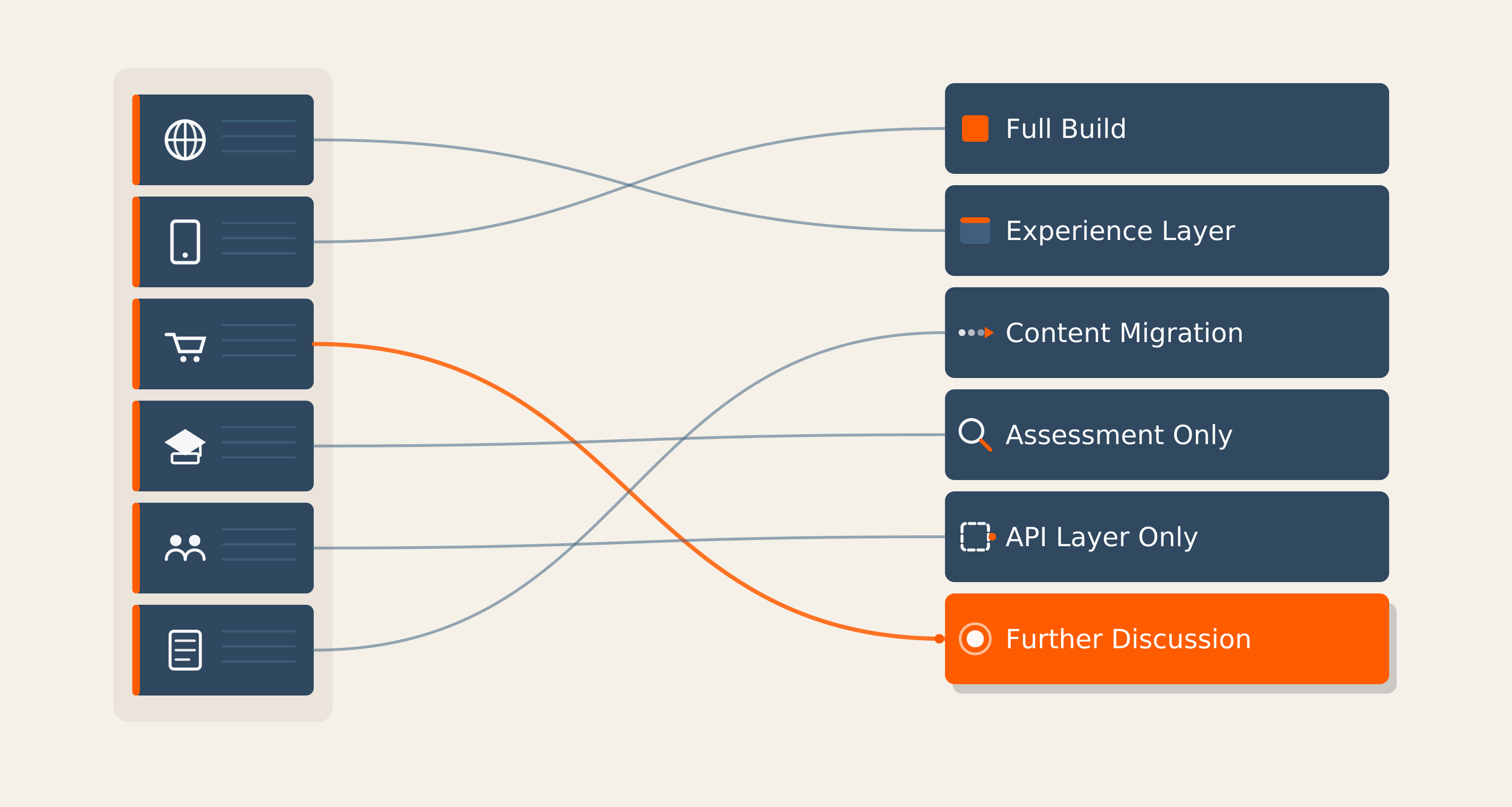
On a recent program involving eight distinct digital platforms and three mobile applications, we developed a six-category classification system that allowed us to scope each platform precisely without forcing binary choices. The categories:
1. Full Build: The platform is being rebuilt, re-platformed, or comprehensively re-architected. This is the highest-investment category and should be reserved for the properties where the existing platform genuinely cannot support the required experience, rather than for properties where the platform is adequate, but the design is dated.
2. Experience Layer: The platform's backend remains unchanged. The user-facing experience is consolidated into a new unified interface that reads from the existing platform via API. The Experience layer is the right classification for platforms that are stable and integrated, but whose experience is inconsistent with the primary digital estate.
3. Content Migration: The content moves to the primary platform; the source platform is retired. No significant feature development. No IA redesign. The value is consolidating editorial workflows and domain authority.
4. Assessment Only: The platform is audited across content, SEO/AEO footprint, technical dependencies, and traffic, but no work is executed. This produces a consolidation roadmap for Phase 2 without committing Phase 1 capacity to a platform that may not yet be ready for migration.
5. API Layer Only: The platform stays completely untouched. Its data is exposed via API into the primary experience. This is the right classification for mature, stable backend systems where the investment in replatforming is not justified by the benefit.
6. Further Discussion Required: The platform's scope cannot be determined until specific decisions are made: vendor transitions confirmed, business model questions answered, or strategic reviews completed. Flagging a platform this way represents an honest acknowledgment that some scope decisions require information that does not yet exist.
The most useful thing a classification framework does is make 'Further Discussion Required' a legitimate and visible category, rather than forcing a false precision that becomes a change request later.
What The Framework Reveals
When you apply this classification to a full estate, patterns emerge that are not visible when the scope is treated as binary. Some platforms that appear to be candidates for Full Build are actually better suited to the Experience Layer, with significant savings in time and budget. Some platforms that were expected to be out of scope turn out to be required API dependencies for features in the Full Build platforms.
The 'Further Discussion Required' category is particularly revealing. On most programs, there are one or two platforms where the scope question cannot be answered honestly without a business decision that has not yet been made. Naming this explicitly, rather than making an assumption and discovering the error mid-program, is one of the highest-value things a scoping exercise can do.
Using The Classification In Practice
The classification is most useful when it is produced before the first IA workshop and distributed to all stakeholders in advance. This ensures that every workshop participant arrives with the same understanding of what is being designed and what is not, and that scope questions, when they arise, have a documented answer rather than requiring a real-time decision.
It is also a living document. As the program progresses, 'Further Discussion Required' items get resolved and move into one of the other categories. 'Assessment Only' items produce roadmaps that shape Phase 2 commitments. The classification framework becomes the governance mechanism that keeps scope honest throughout the program lifecycle, not only at the beginning.
Scoping a multi-platform modernization and not sure where each property belongs? Talk to our program strategy team.
Bring this dispatch into a working session - one page in, scoping memo out.
Brief Foyer