
Introduction
When a multi-brand industrial and manufacturing group approached us, they were not asking for a CRM rollout. They were trying to resolve a growing lack of confidence in how customer data moved across their organization. The group operated across four brands, each at a different level of maturity. One brand was already using HubSpot CRM, while others relied on a mix of ERP workflows, marketing automation tools, form platforms, and spreadsheets.
Individually, these systems performed well. Collectively, they depended too heavily on manual effort, workarounds, and institutional knowledge to stay aligned. Customer interactions across marketing, sales, and service were fragmented, making it difficult to understand the full customer journey or coordinate effectively across brands.
Leadership sought a clearer, more reliable foundation. They wanted an approach that could deliver end-to-end visibility across marketing, sales, and service, support multiple brands within a shared architecture, and integrate cleanly with their ERP. Just as importantly, they wanted a path forward that balanced structure with pragmatism, strengthened adoption over time, and created confidence before introducing additional complexity.
This situation reflects a pattern we frequently see in industrial organizations that have grown through expansion and acquisitions, where systems evolve faster than shared data foundations.
Challenges: What Was Preventing A Connected Customer Journey
Across industrial and manufacturing organizations that have grown through expansion, acquisitions, and the addition of new business lines, a consistent set of challenges tends to emerge. These issues rarely appear overnight. They accumulate gradually as each business unit makes localized decisions to solve immediate needs.
In this case, the challenges reflected patterns we see repeatedly in similar organizations.
- Fragmented Systems Created Over Time: As new businesses and brands are added, systems are often selected independently. ERP platforms, marketing tools, e-commerce systems, and spreadsheets coexist without a unifying structure. Over time, this results in customer data spread across multiple platforms, with no single timeline that captures marketing, sales, and service interactions end-to-end.
- Process Gaps Filled By Manual Workarounds: When systems are not designed to work together, teams compensate through inbox-based workflows, spreadsheets, and informal handoffs. Sales and customer service teams rely on ERP systems for quotes and orders, while context, follow-ups, and communication history live elsewhere. These workarounds increase effort, introduce risk, and make processes harder to scale.
- Multi-Brand Operations Without Shared Context: In multi-brand environments, customers frequently interact with multiple business units. Without shared visibility, teams operate in silos, leading to duplicate outreach, inconsistent messaging, and missed opportunities for cross-selling and coordinated engagement.
- Sales And Marketing Operating On Separate Planes: Marketing activity and engagement data often live outside the systems used by sales teams. As a result, sales lacks visibility into prior interactions, campaign influence, and lead quality. This disconnect limits alignment and weakens confidence in handoffs between teams.
- Leadership Visibility Constrained By Manual Reporting: As complexity increases, leadership reporting often depends on manual consolidation across systems and brands. Pipeline health, forecasting, and performance insights require spreadsheets and reconciliation, making it difficult to trust the data or act on it quickly.
These challenges are not the result of poor decisions. They are the natural byproduct of growth without an overarching architectural and governance model to keep systems, processes, and teams aligned.
Taken together, these challenges created an environment where teams worked hard to bridge gaps manually, but confidence in the system steadily eroded. Addressing this required more than adding another tool. It required rethinking how engagement, operations, and governance should work together.
Designing A HubSpot-Centered Engagement Architecture
With the challenges clearly understood, the focus shifted to designing an engagement architecture that could restore confidence in customer data while remaining practical to adopt across brands. The intent was not to implement tools quickly, but to define a foundation that could support growth, governance, and visibility over time.
A central question guided the design: where should customer engagement live in a multi-brand environment that already depended on an ERP for operations and finance?
Establishing A Central Engagement Layer
As the team evaluated how to unify customer context across sales, marketing, and service, the need for a central engagement layer became clear. One brand was already using HubSpot CRM, providing a proven starting point and reducing risk. More importantly, HubSpot offered a shared data model that could support customer engagement across brands without forcing identical processes.
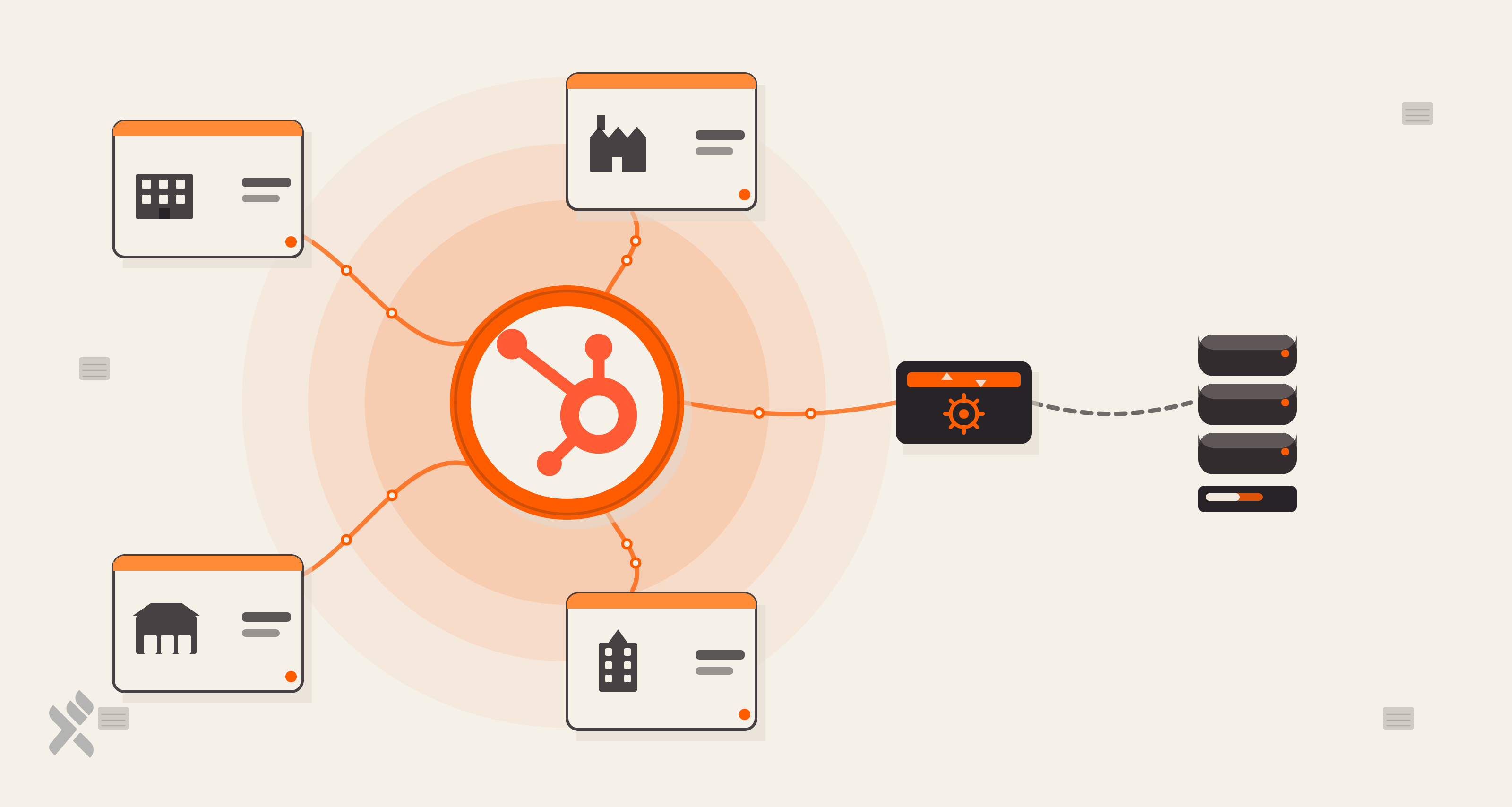
We positioned HubSpot as the system of record for engagement. Contacts, companies, activities, and deals live in one place—creating a single customer timeline across four brands that sales, marketing, and service teams can rely on without reconciling data from separate platforms. This timeline was intended to reflect how customers actually interacted with the organization, rather than fragmenting those interactions across systems and inboxes.
At the same time, the design deliberately avoided imposing uniform workflows across brands. Brand-specific pipelines, stages, and processes could coexist within a shared engagement foundation, preserving flexibility while improving visibility at the group level.
Defining Clear System Boundaries For Governance
Confidence in the CRM could not be rebuilt without clear ownership of data and workflows. Our first architectural decision was to explicitly define and document system-of-record boundaries between HubSpot and the ERP—boundaries that are often assumed but rarely written down, which is where data drift originates.
In this model, HubSpot was designed to own engagement and coordination, including customer interactions, pipeline progression, and follow-up activity. The ERP would continue to own operational and financial processes, including quotes, orders, invoicing, and fulfillment. This separation was intentional. It reduced ambiguity, avoided conflicting updates, and ensured that each system played to its strengths.
By clarifying these boundaries early, the architecture avoided the common pitfall of syncing everything everywhere, which often leads to data drift and a decline in trust over time.
Using Middleware As A Control Layer, Not A Connector
To support these system boundaries, the architecture incorporated a middleware layer between HubSpot and the ERP. Rather than relying solely on direct point-to-point integrations, middleware was designed to act as a control layer for data exchange.
This layer was intended to manage identity matching, deduplication, validation rules, and error handling consistently. It also allowed integration logic to evolve without tightly coupling HubSpot and the ERP, preserving flexibility as systems and volumes changed.
Where appropriate, lighter-weight automation via Zapier was considered for tactical workflows, but only when governance and data integrity would not be compromised. This balance allowed automation to improve efficiency without undermining trust in the system.
Designing For Multi-Brand Reality
Another critical design consideration was how to support multiple brands within a shared CRM architecture.
Each brand operated with different customers, sales motions, and levels of maturity. A rigid, one-size-fits-all model would have slowed adoption and increased resistance. At the same time, leadership needed consolidated visibility across the group.
The architecture was designed to balance these needs. Shared engagement foundations, consistent identity rules, and common governance standards provided a reliable core. On top of that, brand-specific segmentation, permissions, pipelines, and reporting allowed each business unit to operate in ways that reflected its reality.
This approach gave leadership a unified view of pipeline, performance, and customer activity, while allowing teams to retain autonomy where it mattered most.
Enabling A Connected And Measurable Revenue Journey
With a defined engagement layer and governance model, the architecture was designed to connect marketing, sales, and service into a single, measurable revenue journey.
HubSpot Marketing Hub was introduced as a logical extension of the engagement architecture. Proposing migration from the existing marketing automation platform to ensure marketing interactions align with the same customer timeline as sales and service activity. This would make campaign engagement visible to sales teams, improve handoffs, and support clearer attribution of marketing activity to pipeline and revenue.
Reintroducing service workflows at a later stage was also part of the design. Customer service interactions could be captured alongside sales and marketing engagement without attempting to replace ERP-driven operational processes. This ensured continuity across the customer lifecycle while respecting existing operational systems.
From a leadership perspective, this architecture was designed to support consistent reporting on pipeline health, revenue by brand, and performance across teams. For frontline teams, the intent was to reduce friction, improve context, and make the system easier to trust and adopt.
Designing The Engagement In Phases, Not Silos
As the work progresses, the engagement has been intentionally framed as a phased program rather than a series of isolated initiatives. At this stage, the focus is on discovery, with sales, marketing, service, and operations all involved in shaping a shared understanding of how the customer journey works across brands.
This discovery phase is designed to create alignment before any configuration or integration decisions are finalized. By examining processes, data flows, and system roles together, the organization can surface dependencies and constraints early, reducing the risk of introducing complexity that would later need to be undone.
The phased structure is also shaping how the future rollout is being designed. Early phases are revealing the need to establish a stable engagement foundation and improve visibility without disrupting core operational workflows. Subsequent phases are being defined to introduce deeper automation, expanded marketing capabilities, and service workflows once teams have confidence in the system and data.
By approaching the work this way, the engagement is being designed to balance progress with pragmatism. Discovery informs design, design informs sequencing, and sequencing is intended to support adoption and trust as the organization moves forward.
The Discipline Behind A Connected Revenue Engine
This engagement reflects a familiar reality for growing industrial organizations. Systems evolve, brands diversify, and customer data becomes harder to trust over time.
What makes this work meaningful is not the platforms introduced, but the clarity they create. The discipline behind it is consistent across every Axelerant HubSpot engagement: infrastructure first, configuration second. Before workflows are automated, system boundaries are defined. Before dashboards are built, data ownership is clarified. Before integrations are connected, identity logic is stabilized. That sequencing is what allows HubSpot to operate as the foundation of a revenue engine, rather than another operational layer bolted onto an already fragmented estate.
This same approach is why Axelerant was recently recognized as a HubSpot Gold Solutions Partner, a tier that validates consistent customer impact, platform-wide competency, and the ability to architect HubSpot as a connected revenue system across complex, multi-brand environments. The recognition reflects exactly the kind of work this engagement represents: moving organizations beyond tool adoption toward systemic clarity.
For leadership teams in similar industrial organizations, the real challenge is rarely choosing technology. It is creating the conditions in which technology can be trusted to support growth. Once that clarity exists, the platform choices become far easier to make, and the architecture becomes designed to scale across brands without eroding trust.
Axelerant can help you architect a connected, governed, and scalable revenue ecosystem, with the same discipline that shaped this engagement. Let’s build it the right way →
Bring this dispatch into a working session - one page in, scoping memo out.
Brief Foyer